Categories
Finance Solutions

What Is a Consumer Buy-to-Let Mortgage? Regulations Explained

What Is a Consumer Buy-to-Let Mortgage?

Regulations Explained

Get Free Consultation
Published by Tapton Capital
2026

What Is a Consumer Buy-to-Let Mortgage? Regulations Explained

A consumer buy-to-let (CBTL) mortgage is a specialist type of buy-to-let loan designed for accidental landlords, people who rent out a property due to life circumstances rather than deliberate investment plans. In most cases, the property was originally purchased as a home to live in or has been inherited and later becomes a rental property.

Unlike a standard buy-to-let mortgage, a consumer buy-to-let is regulated in the same way as a residential mortgage, offering stronger financial protections and stricter lending checks. This added regulation exists because the borrower is not viewed as a professional property investor.

Market Activity

According to trade body data from UK Finance Buy‑to‑Let Lending data, nearly £11 billion worth of buy-to-let mortgages were advanced in just one quarter of 2025, highlighting sustained market activity.

How a Consumer Buy-to-Let Differs from a Regulated Buy-to-Let

Although the names sound similar, a regulated buy-to-let and a consumer buy-to-let serve different purposes.

A regulated buy-to-let is typically restricted to homeowners who wish to rent their property to immediate family members only, such as parents or children. Even extended relatives, such as cousins, would not usually qualify as acceptable tenants under this arrangement.

A consumer buy-to-let, by contrast, allows the property to be rented on the open market. The key conditions are that:

Consumer Buy-to-Let Key Conditions

  • The property was not originally bought to generate profit
  • The borrower does not own other rental properties
  • Letting the home is not intended to become their main income

In essence, the difference lies in intent and tenant flexibility, not merely regulation.

Why Consumer Buy-to-Let Mortgages Are Regulated

Consumer buy-to-let mortgages fall under the oversight of the Financial Conduct Authority (FCA).

This ensures borrowers receive protections similar to those offered with standard residential mortgages, including:

FCA Protections for CBTL Borrowers

  • Suitability and affordability checks - Comprehensive assessment of your financial situation
  • Transparent disclosure of fees and risks - Full transparency on all costs and potential risks
  • Access to formal complaint and redress systems - Protection through official channels if issues arise
  • Mandatory qualified advice from FCA-registered advisers - Professional guidance from authorised experts

Anyone providing mortgage advice for a CBTL product must be authorised and registered with the FCA, reinforcing consumer protection standards.

How a Consumer Buy-to-Let Mortgage Works

A consumer buy-to-let mortgage functions much like a traditional buy-to-let loan, but with residential-style regulation and more cautious lending criteria.

While many buy-to-let mortgages are interest-only, CBTL products frequently allow capital repayment options, which may be easier to qualify for unless the borrower plans to sell the property at the end of the term or has a clearly documented repayment strategy.

Lenders typically assess:

Lender Assessment Criteria

  • Personal income affordability - Often using around 4-4.5× annual income
  • Projected rental income - Expected rental yield from the property
  • Creditworthiness and age limits - Credit history and age restrictions
  • Deposit size and Loan-to-Value (LTV) ratio - Typically requiring 25% deposit (75% LTV maximum)

Most lenders offer a maximum of 75% LTV, meaning the borrower must provide a 25% deposit.

Eligibility and Ownership Criteria

Qualifying for a consumer buy-to-let mortgage can be more challenging than for a standard buy-to-let because lenders must verify that the borrower truly fits the "accidental landlord" profile.

Common requirements include:

Common CBTL Requirements

  • Proof that the property was not purchased with letting in mind
  • Evidence that rental income will not replace primary earnings
  • Confirmation that you or a close relative previously lived in the property
  • Demonstration that you own no other rental properties
  • Meeting minimum rental coverage ratios, often 125-145% of repayments
  • Providing an income and expenditure plan if requested

Important Note

Some lenders may only offer CBTL products to remortgage customers or as part of a let-to-buy arrangement. It's essential to check with individual lenders about their specific eligibility criteria.

Situations Where a CBTL Mortgage Is Helpful

A consumer buy-to-let mortgage is particularly suitable in the following scenarios:

1

Temporary Relocation

If work or travel requires you to live elsewhere for an extended period beyond a typical "consent to let" agreement.

2

Inherited Property

If you inherit a home and prefer to rent it rather than sell it, helping cover maintenance or existing mortgage costs.

3

Moving to a New Home

If you are relocating or moving in with a partner but do not wish or are unable to sell your existing property.

4

Let-to-Buy Arrangements

When remortgaging your current home onto a buy-to-let product to release equity for a deposit on a new residence.

Rental Yield and Property Assessment

Before applying, lenders often prefer borrowers to obtain a professional rental income estimate from a registered letting agent, commonly affiliated with the Association of Residential Letting Agents (ARLA).

This helps establish realistic rental yield expectations and supports affordability calculations.

Key Differences: Consumer vs Standard Buy-to-Let

Feature Consumer Buy-to-Let Standard Buy-to-Let
Borrower Type Accidental landlord Professional / portfolio landlord
Regulation FCA regulated Usually unregulated
Property Intent Previously lived in Bought to rent
Income Reliance Secondary income only Primary investment income
Advice Requirement Mandatory qualified advice Not always required

How to Apply for a Consumer Buy-to-Let Mortgage

1

Estimate Rental Yield

Obtain a professional rental income estimate through a qualified letting agent.

2

Contact Your Existing Lender

Check if switching to a CBTL product is possible with your current mortgage provider.

3

Compare Products

Not all lenders offer CBTL options, so research available products in the market.

4

Consult a Mortgage Broker

Work with a mortgage broker to assess eligibility and identify suitable deals.

5

Prepare Documentation

Gather proof of prior occupancy, income records, and expenditure plans as required.

Because criteria differ between lenders, professional guidance often improves approval chances and ensures the mortgage aligns with your circumstances.

Final Perspective

Making the Right Choice for Accidental Landlords

A consumer buy-to-let mortgage exists to support homeowners who become landlords by circumstance rather than strategy. It combines the flexibility of renting on the open market with the safeguards of residential-style regulation.

For individuals navigating relocation, inheritance, or transitional housing decisions, CBTL mortgages provide a structured and protected pathway into property letting without entering the realm of commercial landlordism.

Frequently Asked Questions

What does 'consumer buy-to-let' mean?

A consumer buy-to-let refers to a mortgage designed for accidental landlords, people who rent out a property due to life changes such as relocation, inheritance, or moving in with a partner, rather than buying a home specifically as an investment.

Is a consumer buy-to-let mortgage regulated?

Yes. Consumer buy-to-let mortgages are regulated by the Financial Conduct Authority (FCA), which means borrowers receive similar protections to those applying for a standard residential mortgage, including affordability checks and complaint rights.

How is a consumer buy-to-let different from a standard buy-to-let?

The main difference is intent:

  • Consumer BTL: You did not originally purchase the property to rent it out.
  • Standard BTL: The property was bought deliberately as an investment for rental income or portfolio growth.
Do I need a larger deposit for a CBTL mortgage?

Usually yes. Most lenders require a minimum 20-25% deposit, and many cap borrowing at 75% Loan-to-Value (LTV).

Can I rent the property to anyone?

With a consumer buy-to-let, you can generally rent on the open market. The key rule is that the property must not have been purchased with the original intention of making a profit, and you should not own multiple rental properties.

Need Help with Consumer Buy-to-Let Mortgages?

If you're considering a consumer buy-to-let mortgage and need guidance on eligibility, regulations, or finding the right product, Tapton Capital can help. Our specialist team provides expert advice on property finance, helping you understand your options, navigate FCA requirements, and make informed decisions. Contact us today for a free consultation.

Get Free Consultation Call Now
Categories
Finance Solutions

Can You Rent Out Your First Home? ‘Consent to Let’ Guide

Can You Rent Out Your First Home?

'Consent to Let' Guide

Get Free Consultation
Published by Tapton Capital
2026

Can You Rent Out Your First Home? 'Consent to Let' Guide

The days of the lazy tenant farmer are quickly disappearing. In case you are asking, can you rent your first home? In the current market, you are not merely looking at a simple side-income business venture but entering a controlled business world that requires legal knowledge, financial management and business discipline. Renting a property in 2026 and further is not only about giving keys to customers, but also becoming a professionally working and compliance-driven housing provider is possible.

You can rent out your first house, but with the right permissions, safety and legal standards, and if you know the long-term financial consequences of this action, the answer is yes. It is based on the process of lender approval called consent to let, which is by no means the endgame.

What Does Leasing Out Your First Home Entail?

In the instance of renting your first house, you are turning a house initially funded to be used by oneself into a controlled rental property. Mortgage lenders gave you the loan hoping that you would reside there. Releasing it without their knowledge is not just a slight lapse; this is seen to be a violation of terms in the mortgage, which, under serious circumstances, can be addressed as mortgage fraud, and the loan can face an immediate recall.

Important Warning

Renting your property without informing your mortgage lender is a violation of your mortgage contract and can be considered mortgage fraud. You must obtain written Consent to Let before advertising the property to tenants.

The contemporary landlords should also appreciate the fact that renting is not a hobby anymore. You are not going into the informal side business but rather a service industry that is regulated by compliance structures due to legislative changes, the implementation of digital tax reporting systems, and the stricter energy efficiency requirements.

What Is Consent to Let?

Consent to Let is permission by your mortgage lender to temporarily rent out a property with your existing residential mortgage.

It is disbursed mostly upon a short time or unforeseen events in life, including:

Common Reasons for Consent to Let

  • Moving the job or foreign placement
  • Moving in with a partner
  • Interim financial stress
  • Making an inheritance of a second property
  • Before selling the property, the rental market is tested

Authorisation to permit is seldom permanent. Lenders generally consider it as a short-term (typically in 6-24 months) solution. Unless making a long-term plan, you might have to re-rate to a buy-to-let mortgage that is done in a different manner and valued based on estimated rental payments instead of individual salary only.

The Reason Why Renting Your First House Is Now Business

The current environment of landlords is set by three big pressures:

Key Market Pressures for Landlords

Tenancy Reform and Reduced Eviction Flexibility

Legislative changes are making tenants more secure, i.e., landlords are compelled to depend more on the soundness of tenant screening as opposed to the convenience of easy termination services.

Digital Tax Compliance

The move towards the use of digital record-keeping and quarterly financial reporting is taking over informal bookkeeping.

Future EPC Projections

Future EPC aims are getting stricter, and it will transform those homes that are rated poorly into a potential stranded asset, which will have to be upgraded at a high cost to be legally rented.

This is a combination that compels first-time landlords to change their mindsets from being an accidental landlord to strategic asset management.

Financial Validity: Does It Pay for Itself?

Prior to selling your house, you need to check the sense of numbers. The cost of maintenance is on the increase, and the interest rates are high, so the rent is not always profitable.

Viable determination could be done by a simple computation of yield, which is annual rent/value of property. Nonetheless, yield is insufficient. You must also consider:

Financial Considerations

  • Fluctuations in the mortgage interest rates
  • Costs of compliance and maintenance
  • Letting agent/management fees
  • Insurance premiums
  • Possible inter-tenant vacancies

A house that seems to be lucrative on paper might soon turn out to be a liability once there is non-observation of compliance upgrades, taxation expenses, or house vacancy rates.

Tax Obligations and e-Reporting

In the UK, rental income is liable to income tax, and landlords have to declare the earnings by way of self-assessment. One of the most important rules that can impact many owners is Section 24, which limits mortgage interest deductions. Landlords are given a reduced tax credit in lieu of deductions of interest prior to computing the taxation, which in effect bolsters the taxable income of those in the higher bracket of earners.

Section 24 Tax Impact

Section 24 limits mortgage interest deductions. Instead of deducting interest before calculating tax, landlords receive a reduced tax credit, which effectively increases taxable income for higher-rate taxpayers.

Already, as well, is the shift towards Making Tax Digital (MTD), which requires landlords who earn above some specified income limits to keep digital records and present frequent reports to HMRC. It is becoming unpopular to keep the old system of a shoebox of receipts, and the early implementation of the accounting software will be more of a functional need than a list of options.

Mortgage Permissions and Insurance

Normal home insurances tend to become ineffective when tenants occupy the house. You will have to buy expert landlord insurance that usually covers loss of rent, property owner liability and legal costs. Watch out for the unoccupancy clauses, as most policies limit the coverage when a property is not used long-term.

Landlord Insurance Requirements

Standard home insurance becomes invalid when tenants occupy the property. You must obtain specialist landlord insurance that covers loss of rent, property owner liability, and legal costs. Be aware of unoccupancy clauses that may limit coverage during extended vacancies.

At the same time, do not think that your lender would just grant permission to let. Let a written agreement be necessary. In its absence, you are likely to be subject to financial fines and even the recalling of your mortgage.

Safety and Legal Compliance: The Non-Negotiables

Your property should be safe, compliant and legally rentable before any tenant resides in it. This includes:

Required Safety Certificates and Compliance

  • Gas Safety Certificate (CP12): Renewed and revalidated by a Gas Safe Engineer every year
  • Electrical Installation Condition Report (EICR): At least one of every five years with satisfactory results
  • Energy Performance Certificate (EPC): At the legal minimum rating
  • Smoke alarms: On every storey
  • Carbon monoxide detectors: In rooms that have fixed combustion devices
  • Fire-safe furniture: In case the property is furnished

In addition to safety, you are to verify local licensing regulations, especially in selective or other licensing. Failure to comply will result in penalties that are not limited and may also nullify the right to insurance or eviction.

Acquisition of Tenants: Prevention Is Better Than Cure

Having better tenant protection and eviction avenues, front-end screening now forms the most important risk management. Locating a tenant does not simply consist of filling a vacancy, but it is making a legally binding business relationship.

Best practice includes:

1

Affordability Checks

Although many landlords refer to a 2.5x-3x income-to-rent ratio, it helps decrease the risk of arrears.

2

Employer and Reference Checking

Confirming employment history and renting history.

3

Right to Rent Checks

Representing the legality of renting in the UK with the assistance of a digital or physical ID.

4

Formal Tenancy Agreements

It should never be based on the informal agreement; a written contract will guarantee the protection of both sides.

Moreover, the pricing strategy should be correct initially. Promoting above-advertised rent bidding wars or offers is becoming limited, which implies the accuracy of valuation is paramount.

Guarantee of Depositing and Documentation

Dealing with tenant deposits is closely controlled. During 30 days of fund receipt, you have to:

Deposit Protection Requirements

  1. Admit the deposit on a government-approved scheme
  2. Present the prescribed information that is stipulated by the law to the tenant

Failure to meet this deadline will attract a penalty of up to three times the amount deposited and may limit your right to obtain legal possession.

Management: Self-Manage or Agent?

Other first-time landlords do not have adequate estimates of operational workloads. The property management incorporates:

Property Management Responsibilities

  • Unsociable hour repairs
  • Laws and control by law
  • Collection of rent and management of arrears
  • Regular check-ups and servicing

An agent with a professional fee also places a barrier on legal liability and lessens administration because the use of a professional agent is often a firewall against lawsuits. It always depends on whether you have time and how much stress you can handle versus the management cost.

When Is It Time to Change to Buy-to-Let?

A buy-to-let mortgage is worth serious consideration in case:

When to Switch to Buy-to-Let

  • Extensions of letting are longer than one or two years
  • Rental earnings are an incremental financial plan
  • Your mortgage holder denies renewal of Consent to Let
  • You buy another household

Buy-to-let arrangements are more consistent with long-term rental plans, and they will estimate their affordability on the basis of anticipated rental income, not on the basis of personal income.

Final Thoughts

Making Informed Decisions About Renting Your First Home

Accordingly, is it possible to rent out your first home? However, preparation, compliance, and strategic thinking are now the keys to success and not convenient. Renting is no longer something to enjoy as a hobby and a painless stream of money; it is a controlled business that demands financial control, legal knowledge and operation planning.

Being treated as a business, your first home could be developed as a strong income-generative property in addition to a place of living. Casually it can very easily turn into a legal and financial liability. The distinction is in the approach towards seeing the process not as a side project, but as an organised, compliance-based business of property.

Frequently Asked Questions

Is it possible to rent your first house without informing your mortgage lender?

No. Renting your original house without the knowledge of your lender is a violation of your mortgage contract as well as mortgage fraud. You will have to acquire a written Consent to Let prior to advertising the property to tenants.

What is the average duration of Consent to Let?

The permission to let is usually issued between 6 and 24 months, as per the lender. It is structured as a short-term arrangement and not as a long-term rental solution. And when it comes to renting long-term, you may be obliged to change to a buy-to-let mortgage.

Can I pay more in terms of mortgage payments by renting my first home?

Possibly. There are lenders who impose an administration fee or impose a slightly higher rate of interest after approval of Consent to Let. The effect of this depends on the lender and mortgage product.

Should I have landlord insurance, or do I have normal home insurance?

Yes. Normal home insurance is normally invalidated after tenants occupy the property, and they require special landlord insurance which covers damages by the tenants, loss of rent and liability of a property owner.

What are the safety certificates required before renting?

At minimum, you will need:

  • Gas Safety Certificate (CP12) annually
  • Every five years, an Electrical Safety Report (EICR)
  • Energy Performance Certificate of E or more
  • Smoke alarms on every storey
  • Where necessary, carbon monoxide alarms

The inability to deliver them may cause severe fines and legal penalties.

Am I liable to pay tax on revenue earned in terms of rent in my first house?

Yes. Income tax is charged on rental income. Earnings have to be reported by yourself. Regulations like Section 24 imply that you cannot deduct mortgage interest in full prior to taxation, which may lead to an increment in your tax liability.

What is Making Tax Digital on the side of landlords?

Making Tax Digital (MTD) is a policy by the government that demands that landlords with defined income limits maintain electronic financial records and report them on a regular basis to the HMRC rather than an annual paper-based report.

What should I do to secure the deposit of a tenant?

Within 30 days you are required to register the deposit with a deposit protection scheme that is approved by the government and supply the tenant with the necessary prescribed information. Failure to meet this deadline may attract up to three times the deposit.

Should one manage it or engage in self-management or use a letting agent?

It will be based on your time, expertise and risk tolerance. Self-managing saves money but entails a good knowledge of compliance, repairs and the tenant law. A letting agent will increase the cost but may decrease the legal risk and administrative burden.

What is the time to change Consent to Let to Buy-to-Let?

You are advised to switch in case you intend to rent for over a year or two, your lender does not agree to continue Consent to Let, or in case rental income becomes a long-term financial plan. Buy-to-let mortgages are constructed in a special way that applies to investment property.

Need Help with Consent to Let?

If you're considering renting out your first home and need guidance on consent to let, mortgage permissions, or property management, Tapton Capital can help. Our specialist team provides expert advice on property finance, helping you understand your options, navigate compliance requirements, and make informed decisions. Contact us today for a free consultation.

Get Free Consultation Call Now
Categories
Finance Solutions

Notice Accounts: Maximise Savings with Flexible Access

Notice Accounts

Maximise Savings with Flexible Access

Get Free Consultation
Published by Tapton Capital
2026

Notice Accounts: Maximise Savings with Flexible Access

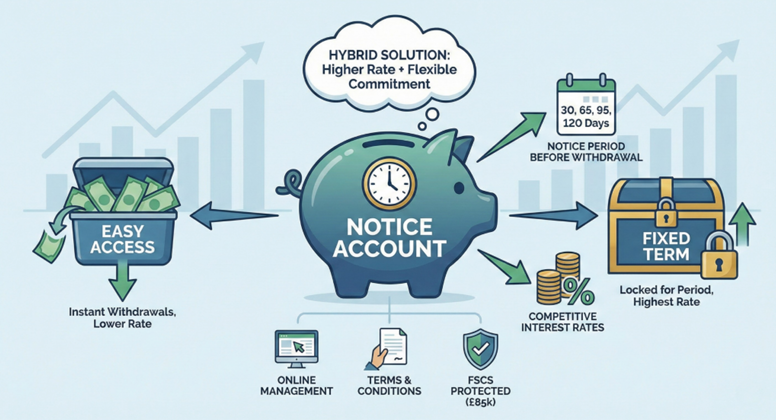
In today's financial landscape, finding the right savings account can be a crucial step towards achieving your financial goals. Among the various options available, the notice account stands out as a hybrid solution, blending the benefits of both easy access and fixed-term accounts. A notice account allows you to earn a higher interest rate than a standard easy access savings account while still providing access to your funds. This is achieved by requiring you to give a notice period before withdrawal.

What is a Notice Account?

A notice account is a type of savings account that offers a higher interest rate in exchange for you agreeing to a notice period before you withdraw funds. This notice period before withdrawal can be anywhere from a few days to several months, depending on the specific terms of the account. Think of it as a middle ground between an easy access account, which allows instant withdrawals but typically offers lower interest rates, and a fixed-term bond, which locks your money away for a set period but usually provides the highest returns. What is a notice account's core function? It helps you earn more without completely restricting access to your funds.

Key Benefits of Notice Accounts

  • Higher interest rates than easy access accounts
  • Flexible access to funds with advance notice
  • Better returns than standard savings accounts
  • Ideal for strategic liquidity management
  • No complete lock-in period like fixed-term bonds

For example, consider someone saving for a down payment on a house. They might want to keep their money relatively accessible in case they find the perfect property sooner than expected. A notice account with a 30-day notice account requirement could be ideal. It offers a better interest rate than an easy access account while still allowing them access to their savings within a reasonable timeframe. This blend of balance, accessibility and growth makes a notice account a powerful tool for strategic liquidity management.

Features and Benefits

Notice accounts come with a range of features and benefits that make them an attractive option for savers who want to earn competitive interest rates without sacrificing all access to their money. Understanding these features is key to determining if an account aligns with your financial goals.

Features of the Set Notice Deposit account

Let's delve into some common characteristics you'll find in a typical notice deposit.

Core Features

  • Higher Interest Rates: Notice accounts generally offer a higher interest rate than easy access savings accounts. This is the primary incentive for accepting the withdrawal notice requirement.
  • Notice Period: This is the defining feature. You must give a notice period, ranging from 35 days, 65 days, 95 days, or even 120 days, before a withdrawal can be made. The length of the notice period impacts the rate offered.
  • Variable or Fixed-Rate Savings Accounts: Some notice accounts offer a variable interest rate, which means the rate can fluctuate with market conditions. Others offer a fixed interest rate for a specified period, providing more certainty.
  • Minimum Deposit Requirements: Most notice accounts have a minimum deposit required to open a notice account today. This amount can vary significantly between financial institutions.
  • Limited Withdrawals: While you can withdraw funds, doing so requires adhering to the notice period. Failing to give a notice period before you withdraw funds might result in a penalty fee or loss of interest.
  • Online Management: Many notice accounts are managed online, providing convenient access to your account and allowing you to track your savings.

The core advantage of a notice account lies in its ability to unlock higher interest tiers while offering a degree of flexible commitment. By accepting the notice period, you demonstrate a commitment to saving, which the financial institution rewards with a more competitive interest rate. This structured savings approach can be particularly beneficial for cultivating disciplined saving habits.

Rates

Interest rates on notice accounts are constantly in flux, influenced by factors such as the overall economic climate and the policies of individual banks. However, as a general rule, the longer the notice period, the higher the interest rates you can expect to receive. It's important to shop around and compare notice accounts from different providers to find the most competitive rates.

Understanding Notice Account Rates

For example, GB Bank's Capital Growth Account might offer a rate, with a higher rate for accounts requiring 95 days' notice compared to those requiring only 35 days' notice. Similarly, Bank of Ireland's 31-day set notice account offers a specific interest rate on deposits, contingent on the 31-day notice period being observed. These examples highlight the direct correlation between the notice period and the potential return on your investment.

Keep an eye on sites that provide competitive analysis of savings products. These resources can help you identify institutions offering the best notice account rates at any given time. Remember, even a small difference in the interest rate can make a significant impact on your savings over the long term. Make sure to factor in the Annual Equivalent Rate (AER) to understand the true annual return.

How Notice Accounts Compare to Other Savings Options

To fully appreciate the value of a notice account, it's crucial to understand how it stacks up against other common savings accounts. Each option has its own set of advantages and disadvantages, making it suitable for different financial goals and circumstances.

Fixed Rate Accounts

Fixed-term accounts, also known as fixed-rate bonds, offer a guaranteed interest rate for a specified period, typically ranging from one to five years. While they often provide the highest interest rates available, they also come with strict conditions. Withdrawals require a significant penalty or are simply not allowed until the maturity dates.

When to Choose Fixed-Term Accounts

Fixed-term accounts are best suited for individuals who have a clear savings goal with a defined timeline and are confident they won't need access to their funds during the term. For example, if you're saving for a wedding that's three years away, a three-year fixed-rate bond could be a good option. However, if you anticipate needing your money sooner, a notice account might be a better choice.

Easy Access Accounts

Easy access accounts offer the ultimate flexibility, allowing you to withdraw funds at any time without restrictions. However, this convenience comes at a cost: easy access savings accounts typically offer the lowest rates.

When to Choose Easy Access Accounts

These accounts are ideal for building an emergency fund or for individuals who need frequent access to their savings. For example, if you want to maintain a financial buffer for unexpected expenses, an easy access account is a sensible choice. However, if you're looking to maximise your returns and don't need immediate access to your money, a notice account can provide a significant boost to your savings.

Fixed Rate Cash ISA

Fixed Rate Cash ISA is a tax-efficient savings account that offers a fixed interest rate for a specified period, similar to a bond. The key difference is that any interest earned within an ISA is tax-free, up to the annual ISA allowance. The current ISA allowance is £20,000 for the 2024/2025 tax year.

If you haven't already used your ISA allowance, a fixed-rate cash ISA can be an excellent way to save tax-free. However, like fixed-rate bonds, they typically have limited access conditions, with withdrawals requiring a penalty.

Opening and Managing Your Notice Account

Opening a notice account is a straightforward process, but it's essential to understand the steps involved and the information you'll need to provide. Financial resilience is achieved through informed decisions, so let's walk through the process.

How to Apply

The application process for a notice account is generally similar across different financial institutions. You'll typically need to provide the following:

1

Personal Information

This includes your name, address, date of birth, and contact details.

2

Identification

You'll need to provide proof of identity, such as a passport or driver's licence.

3

Proof of Address

A recent utility bill or bank statement can serve as proof of address.

4

Tax Information

You may need to provide your tax identification number (e.g., National Insurance number in the UK).

5

Funding Source

The bank will need to know where the funds you're depositing are coming from to comply with AML (Anti-Money Laundering) regulations.

The application can usually be completed online or in person at a branch. Customer onboarding is made easier with online banking platforms.

Book an Appointment

Some banks, like Bank of Ireland, offer the option to book an appointment with a financial advisor to discuss your savings needs and help you choose the right notice account. This can be particularly helpful if you're unsure which account is best suited for your financial goals.

Funding Your Notice Account

Once your notice account is open, you'll need to deposit funds to start earning interest. Most accounts have a minimum deposit amount, which can range from a few hundred pounds to several thousand. What is the maximum balance on notice accounts? It varies, so check the specific terms.

How do I make additional deposits into my notice account?

Most financial institutions offer several convenient ways to deposit funds into an account.

Deposit Methods

  • Electronic bank transfers: This is the most common method. You can transfer funds from another bank account to your notice account using online banking or a mobile banking app. You'll need the account number and sort code for your notice account.
  • Cheque: You can also deposit funds by mailing a cheque to the bank. Make sure to write your notice account number on the back of the cheque.

Accessing Your Funds: The Notice Period

The defining characteristic of a notice account is the notice period. This is the amount of time you must give as a notice period before you can withdraw funds. The length of the notice period can vary, but it's typically 35 days, 65 days, 95 days, or 120 days.

To withdraw funds, you'll need to notify the bank of your intention to make a full withdrawal or partial withdrawals. This can usually be done online, by phone, or in writing. Once the notice period has expired, you'll be able to access your funds.

Important information on using Notice to make withdrawals from your account

It is essential to carefully read the Terms and Conditions before you open a notice account. Here's some key information to keep in mind:

  • Starting the Notice Period: Understand how the notice period is triggered. Does it start the day you submit your withdrawal request or the next business day?
  • Withdrawal Options: Clarify whether you can make partial withdrawals or only full withdrawals.
  • Penalty for Withdrawal: Be aware of any penalty for withdrawal that may apply if you withdraw funds before the notice period has expired. The penalty fee might involve losing a portion of the interest you've earned.
  • Minimum Withdrawal Amount: Check if there's a minimum withdrawal amount.

Understanding these details will help you avoid any surprises when you need access to your funds.

Managing Your Account

Managing your notice account is generally a simple process, especially with the prevalence of online banking. You can typically view your balance, track your interest earnings, and submit withdrawal requests through the bank's website or mobile app. These also provide a savings calculator.

How do I cancel my scheduled transactions?

If you have scheduled a withdrawal and need to cancel it, you should contact the bank as soon as possible. The process for cancelling a scheduled transaction may vary depending on the bank, so it's best to check their FAQs or contact customer support.

Understanding Interest and Taxes

Interest earned on notice accounts is typically subject to tax. However, the amount of tax you pay will depend on your individual circumstances and the applicable tax laws. Understanding DIRT is crucial.

What if my rate changes?

If you have a variable-rate notice account, the rate can change over time, reflecting changes in the market. The bank will typically notify you in advance of any rate changes. If the rate goes down, you may want to consider switching to a different account with a higher rate.

What is the Personal Savings Allowance?

The Personal Savings Allowance (PSA) is a UK tax allowance that allows individuals to earn a certain amount of interest on their savings tax-free. The amount of the PSA depends on your income tax band. For basic rate taxpayers, the PSA is £1,000. For higher-rate taxpayers, it's £500. Additional rate taxpayers do not receive a PSA.

Account Limits and Security

Notice accounts may have certain limits on the amount you can deposit or withdraw funds. These limits are typically outlined in the account Terms and Conditions.

Banks employ robust digital security measures, including data encryption and two-factor authentication, to protect your account from fraud and unauthorised access. KYC (Know Your Customer) and AML (Anti-Money Laundering) are also important compliance measures.

What is the maximum balance on notice accounts?

The maximum balance on notice accounts will vary depending on the financial institution offering the account. Some may have no limit, while others may impose a cap. It's important to check the specific terms of the account before you open a notice account.

Deposit Guarantee Scheme

Your eligible deposits in notice accounts are protected by the Financial Services Compensation Scheme (FSCS). The FSCS Protection Scheme protects up to £85,000 per eligible depositor per financial institution. This means that if the bank were to fail, you would be compensated up to this amount. This is similar to the Deposit Insurance Corporation (FDIC) in the United States.

FSCS Protection Details

Background

The FSCS is the UK's statutory deposit insurance scheme. It was established to protect depositors in the event of a bank failure.

Eligible Deposits

Most deposits held with Financial Conduct Authority (FCA) authorised banks, building societies, and credit unions are eligible for FSCS protection. This includes notice accounts, easy access accounts, and fixed-term bonds.

Protected Depositors

The Deposit Insurance Scheme protects individuals, small businesses, and charities.

General limit of protection

The general limit of protection is £85,000 per eligible depositor per financial institution.

Temporary high balances

Temporary high balances, such as those resulting from the sale of a property, may be protected for up to £1 million for a period of six months.

Limit of protection for joint accounts

For joint accounts, each depositor is protected up to £85,000, meaning a joint account with two depositors would be protected up to £170,000.

Compensation Payment Procedure

If a bank fails, the FSCS will aim to pay compensation within seven days. This can be done via electronic bank transfers.

Terms and Conditions

Before opening a notice account, it's essential to carefully read and understand the terms and conditions. These documents outline the access conditions, interest rate terms, withdrawal procedures, and any fees or charges that may apply. Regulatory compliance is paramount for banks.

To find out more about the product, download our information sheet. Many banks provide detailed information sheets about their notice accounts. These sheets typically provide a summary of the key features and benefits of the account.

Customer Support and Resources

Customer support is a vital aspect of any financial institution. Banks typically offer a range of customer support channels, including online chat, phone support, and email support. They also provide resources such as FAQs and educational materials to help you understand their products and services. Financial literacy is important.

Available Support Resources

  • Online chat support
  • Phone support
  • Email support
  • FAQs and educational materials
  • Customer reviews and testimonials
  • Quick links to important information

Conclusion

Maximising Your Savings with Notice Accounts

In conclusion, the notice account provides a compelling option for savers seeking a balance between access and growth. By understanding the features, benefits, and access conditions of notice accounts, you can make an informed decision that aligns with your financial goals. Remember to carefully consider your liquidity needs and shop around for the most competitive interest rates to maximise returns with notice.

Notice accounts offer a strategic middle ground for savers who want to earn competitive interest rates without completely locking away their funds. Whether you're saving for a house deposit, planning for future expenses, or building your savings portfolio, a notice account can be an excellent tool for achieving your financial objectives while maintaining flexibility.

FAQs

What is the difference between a notice account and a fixed-term deposit?

A notice account requires you to give a notice period before you can withdraw funds, while a fixed-term deposit locks your money away for a set period. Notice accounts typically offer more flexibility than fixed-term accounts.

Is a notice account right for me?

A notice account is a good option if you want to earn a higher interest rate than an easy access account but still need some degree of access to your funds.

What happens if I need to withdraw funds before the notice period?

You may be subject to a penalty for withdrawal, such as losing a portion of the interest you've earned.

How do I choose the best notice account?

Compare interest rates, notice periods, minimum deposit requirements, and any fees or charges before opening a notice account. Also, check the provider's reputation.

Are notice accounts safe?

Yes, eligible deposits in notice accounts are protected by the Financial Services Compensation Scheme (FSCS) up to £85,000 per eligible depositor per financial institution.

Can I top up my notice account?

Most notice accounts allow you to top up the balance at any time. However, it is best to check the specific terms and conditions of the account.

What are the pros and cons of a notice account?

The pros include higher interest rates and some access to your funds. The cons include the notice period requirement and potential penalties for early withdrawal.

How does a notice account benefit business cash flow?

A notice account can help businesses optimise their business cash flow by earning competitive interest rates on short-to-medium-term savings while maintaining some access to their funds.

Where can I find the best notice account rates?

You can find the best notice account rates by comparing accounts from different financial institutions online. Look for comparison websites that provide competitive analysis.

What should I consider before opening a notice account?

Before opening a notice account, you should consider your financial goals, liquidity needs, and risk tolerance. You should also carefully review the Terms and Conditions of the account.

Are there any account-keeping fees associated with notice accounts?

Some financial institutions may charge account-keeping fees for notice accounts. It is important to check the fee structure before opening a notice account.

What are the tax implications of a notice account?

Interest earned on notice accounts is typically subject to tax. However, you may be able to use your Personal Savings Allowance to earn some interest tax-free.

How do I give advance notice to withdraw funds?

You can typically give a notice period to withdraw funds online, by phone, or in writing, depending on the financial institution's procedures.

What is the Yield-Optimised Access Account?

A yield-optimised access account is a type of notice account that aims to provide the best possible interest rate while still allowing some access to your funds.

By understanding the nuances of notice accounts, you can strategically use them to enhance your financial resilience and work towards capital growth.

Need Help with Notice Accounts?

If you're looking to maximise your savings with a notice account, Tapton Capital can help. Our specialist team provides expert advice on savings products, helping you understand your options, compare rates, and choose the right account for your financial goals. Contact us today for a free consultation.

Get Free Consultation Call Now
Categories
Finance Solutions

What is a consumer buy-to-let mortgage?

Consumer Buy-to-Let Mortgage

Complete Guide for Accidental Landlords

Get Free Consultation
Published by Tapton Capital
2026

What is a Consumer Buy-to-Let Mortgage?

A consumer buy-to-let (CBTL) mortgage is a more specific category of buy-to-let mortgage which targets accidental landlords, people who have become landlords because of life events and not as a result of an investment plan. This normally occurs when a house owner leaves an inheritance, takes on employment elsewhere or lives with a partner or even because of renting out a home that the owner is not planning to sell. Under such circumstances, the property was not initially bought in order to make a profit, which is the major aspect differentiating a consumer buy-to-let and a regular business buy-to-let.

A consumer buy-to-let mortgage is also regulated by the Financial Conduct Authority (FCA), unlike the majority of traditional buy-to-let mortgages. This rule will provide borrowers with the same protections as residential mortgages, such as clear lending conditions, affordability tests and qualified financial advice. Any person providing advice on a CBTL product is also required to be FCA-authorised, and there should be professional standards and responsible lending practices.

FCA Regulation Benefits

  • Clear lending conditions and transparency
  • Comprehensive affordability tests
  • Qualified financial advice requirements
  • Professional standards and responsible lending practices
  • Access to complaint resolution through the Financial Ombudsman Service

The market analysts forecast that consumer buy-to-let lending in the UK may reach above 46 billion by the year 2032 due to greater mobility within the housing market, transfer of inheritance, and let-to-buy practices. This expansion indicates the role of CBTL mortgages in the transition between residential property ownership and professional investment in property ownership.

What is the difference between a consumer buy-to-let and a regulated buy-to-let?

The regulated buy-to-let has much tighter restrictions on tenants and is mainly aimed at homeowners renting property to close family members only, e.g., parents or children. Long-time family members such as cousins are normally locked out under lender requirements. This is not meant to be rented to the market but to provide accommodation to the family.

However, a consumer buy-to-let permits the property to be rented in the open market, and some ownership and intent requirements are satisfied. The borrower should prove that:

1

Non-Commercial Intent

The house has not been bought as a commercial investment.

2

Supplementary Income

Rental revenues are not supposed to be the main source of their revenues.

3

Single Property Ownership

They do not possess several rental houses.

4

Previous Residence

They or a very close family member lived in the home before.

The difference revolves around purpose and the classification of the landlords. Controlled buy-to-lets relate to the family tenancy control, and consumer buy-to-lets relate to regulatory circumstantial landlordism.

The mechanism of the consumer buy-to-let mortgage

A consumer buy-to-let mortgage is similar to a normal buy-to-let except that it is evaluated and controlled like a residential mortgage. Lenders consider personal income and estimated rental income and frequently go with an amalgamated model of affordability. This twofold judgement minimises the risk and guarantees that in case of fluctuations in rental earnings, the borrower would still be able to repay.

Key Features of CBTL Mortgages

  • Maximum LTV: Most lenders provide up to 75% loan-to-value (LTV) ratio, requiring a 25% deposit or existing equity
  • Income Multipliers: Personal income is frequently 4 to 4.5 times the annual salary
  • Rental Stress Test: Rental income might be required to be 125-145% of the monthly mortgage payment
  • Repayment Options: Most CBTL lenders offer capital repayment facilities, not just interest-only

Despite the fact that buy-to-let mortgages are traditionally interest-only, most CBTL lenders also offer capital repayment facilities, and they may be more accessible to qualified buyers unless the latter have a clear plan of exit (i.e., selling the property or having a repayment vehicle).

When a Consumer Buy-to-Let Mortgage is Helpful

A CBTL mortgage is especially applicable where situations in life compel one to make a transition between being a homeowner and being a landlord, not in a commercial nature. Common scenarios include:

Temporary Movement or Long Travelling

When a homeowner travels to work overseas or does long-term travelling, a longer-term compliant rental option is available using a consumer buy-to-let.

Inheriting a Property

In cases whereby a person inherits a house with a mortgage or with a continual maintenance fee, renting the property under a CBTL will be beneficial in offsetting the cost without necessarily selling the property immediately.

Moving in With a Partner or Upsizing

As an alternative to selling a former house, a homeowner can decide to rent the house to cover any outstanding mortgage debt or receive additional income.

Let-to-Buy Arrangements

During a let-to-buy transition, a borrower refreezes the mortgage of his or her existing residence to a CBTL product to obtain a deposit to fund a new residential acquisition. It is a process which some lenders require to be CBTL classified.

Important Differences between Consumer Buy-to-Let and Standard Buy-to-Let

Feature Consumer Buy-to-Let Standard Buy-to-Let
Borrower Type Accidental landlord Professional investor
Regulation FCA regulated Often unregulated
Property Intent Previously lived in Purchased to rent
Income Source Supplementary Primary business income
Tenant Type Open market allowed Open market
Ownership Limit Usually one rental property Multiple properties permitted

The fundamental distinction is in commercial intent verification. Borrowers of CBTL are required to demonstrate the lack of a profit motive in investment, whereas the standard buy-to-let borrowers have clear business targets.

Calculations of Borrowing Limits and Affordability

Lenders will determine your affordability based on a mixture of:

Affordability Assessment Factors

  • Individual wage multipliers: Typically 4-4.5 times yearly earnings
  • Stress tests on rental income: 125-145% repayment coverage
  • Debt ratios and creditworthiness: Overall financial health assessment
  • Limit in age and feasibility of mortgage term: Age restrictions may apply
  • Deposit or equity requirements: Typically 25% minimum

Personal income is favoured more by some lenders, and other lenders place more emphasis on the rental projections. The assessment is similar to residential underwriting, though it uses landlord-specific financial modelling.

Eligibility Requirement and Proof of Ownership

A consumer buy-to-let may be more difficult to qualify for than a business buy-to-let since the lender may need extra documentation as to the accidental nature of the landlord. The applicants can be required to show:

Required Documentation

  • The property was not bought with the purpose of letting
  • Employment income will not be substituted by rental income
  • The home used to be occupied by them or a close relative
  • They do not hold other rental houses
  • An organised income and expenditure budget
  • There is evidence that the circumstantial changes and not strategy produced landlord status

Other requirements may be different. There are those lenders that will just accept remortgage applicants and those that will only grant CBTL in the arrangement of the let to buy.

The Mortgage Broking and Comparison of Products

Due to the variation in CBTL requirements among lenders, there is a large number of borrowers who use FCA-approved mortgage brokers who compare products available, calculate the ratio of rental coverage, and align the borrower circumstances with the lender policies. Brokers also assist in transiting residential mortgages to consent-to-let permission, CBTL products and full business buy-to-let mortgages, which constitutes an articulated mortgage lifecycle route.

Benefits of Using a Mortgage Broker

An FCA-approved mortgage broker can help you navigate the complex CBTL market, compare products from different lenders, calculate rental coverage ratios, and ensure your circumstances align with lender policies. They can also assist with transitions between different mortgage types as your situation evolves.

Monetary Securities and Risk Insurance

FCA oversight ensures:

Consumer Protection Under FCA Regulation

  • Open fee disclosures: All fees must be clearly disclosed upfront
  • Reasonable affordability tests: Lenders must assess your ability to repay
  • Qualified advice standards: Advisers must be properly qualified and FCA-authorised
  • The spokes of complaint resolution: Access to the Financial Ombudsman Service
  • Ethical lending and advertising: Fair treatment and transparent marketing

These guarantees give less exposure to inappropriate financial obligations and focus the borrowing experience more after the residential mortgage security.

Long-Term Considerations and Market Outlook

The consumer buy-to-let sector continues to expand due to increased inheritance transfers, job mobility, and evolving housing patterns. Though CBTL mortgages are not geared towards the mass construction of portfolios, they are a legal and systematic pathway allowing temporary or provisional proprietors of land. With time, there are cases where borrowers are born as professionals in terms of landlords; hence, after shifting the intent and income sources, they switch to business buy-to-let products.

Market Growth

Market analysts forecast that consumer buy-to-let lending in the UK may reach above £46 billion by the year 2032. This growth is driven by greater mobility within the housing market, transfer of inheritance, and let-to-buy practices.

The clear understanding of the difference between intent and regulation and the affordability mechanics and ownership proof enables borrowers to choose the right type of mortgage and prevent regulatory misalignment. Essentially, a consumer buy-to-let mortgage is not merely a financial service; it is also a consumer regulation framework which acknowledges the development of real-life housing circumstances to go beyond the act of buying and selling.

FAQs

What is a consumer buy-to-let mortgage?

Consumer buy-to-let (CBTL) mortgage is a loan that targets individuals who do not make the decision of becoming a landlord but do so accidentally. It is intended to enable homeowners to rent an existing property that they already own more frequently because of an inheritance, relocation, or cohabitation with a partner and still have the regulatory protection of a residential-type mortgage.

What is meant by a consumer buy-to-let as compared to a standard buy-to-let?

The largest disparity is deliberate. A consumer buy-to-let is used in cases where the property was not purchased to make a profit or investment, and a normal buy-to-let is one whereby a professional landlord acquires property with the express aim of making money. The FCA regulates CBTL mortgages and not many of the usual buy-to-lets.

Who is an accidental landlord?

An accidental landlord can be described as a person who did not initially intend to rent out a property but finds himself stuck in such a situation due to circumstances in life. Examples of some of these are the passing of a home, moving to work, getting into a let-to-buy scheme, or failing to sell a former house in the event of a house move.

What is the maximum amount I can borrow using a consumer buy-to-let mortgage?

The majority of the lenders provide up to 75% loan-to-value (LTV); that is, you will typically be required to deposit a minimum of 25% of the loan value or the equivalent portion of equity. The affordability is commonly evaluated based on a combination of personal income (approximately 4-4.5 x annual salary) and potential rental income, and stress tests on rentals are normally pegged at 125-145 per cent of monthly payments.

Is it possible to borrow a consumer buy-to-let mortgage for various rental properties?

No, in the vast majority of instances you have to own other properties on rental to be eligible. CBTL mortgages are to be offered to single-property, non-commercial landlords. When you start to acquire more rental residential properties, the lenders might insist on you changing to a business buy-to-let mortgage.

Is rental income obligatory to be qualified?

Rental income is naturally taken into consideration, yet most frequently lenders require that you should be able to pay back using only your own income. This twofold valuation makes the property stable in the event when there is no occupancy or late rental due.

Conclusion

Understanding Consumer Buy-to-Let Mortgages

Consumer buy-to-let mortgages provide a regulated pathway for accidental landlords who find themselves renting out property due to life circumstances rather than investment strategy. With FCA regulation providing consumer protections similar to residential mortgages, CBTL products offer a secure option for homeowners transitioning to landlords.

The key to successfully navigating CBTL mortgages lies in understanding the eligibility requirements, demonstrating the accidental nature of your landlord status, and working with FCA-authorised mortgage brokers who can help you find the right product for your circumstances. Whether you're inheriting property, relocating for work, or entering a let-to-buy arrangement, a consumer buy-to-let mortgage may be the appropriate solution for your needs.

Need Help with Consumer Buy-to-Let Mortgages?

If you're an accidental landlord looking for the right mortgage solution, Tapton Capital can help. Our specialist team provides expert advice on consumer buy-to-let mortgages, helping you understand eligibility requirements, compare products, and secure the right financing for your circumstances. Contact us today for a free consultation.

Get Free Consultation Call Now
Categories
Finance Solutions

Buying a House in the UK: How Does It Work? The Ultimate Step-by-Step Guide

Buying a House in the UK: How Does It Work?

The Ultimate Step-by-Step Guide

Get Free Consultation
Published by Tapton Capital
2026

Buying a House in the UK: How Does It Work? The Ultimate Step-by-Step Guide

How does buying a home work in the UK? Discover the entire step-by-step process of buying a home, from budgeting to mortgages, legal checks and completion.

Understanding the process of buying a house

The process of buying a home is a legal and financial one that involves the transfer of ownership from the seller to the buyer. Understanding how to buy a home can help you make informed decisions throughout the process. The buyer first agrees to buy a house, then secures any financing needed, performs legal checks, signs contracts and completes the deal.

The buyer will work closely with the estate agent, mortgage lender, and legal representative from the beginning (also called a conveyancer, solicitor, or lawyer). Each party plays a specific role in ensuring that the transaction is legal, transparent and secure. It is important to note that ownership doesn't legally transfer until the transaction has been completed and the property registered at HM Land Registry.

For comprehensive official guidance on the home buying process, you can refer to the UK Government's official guide on how to buy a home, which provides detailed information on each stage of the process.

How to Assess Your Finances and Affordability

Buyers should consider affordability before viewing properties. It is important to review your income, expenses, savings and credit history. Mortgage lenders conduct affordability assessments to determine whether the repayments can be managed over time. Both the buyer and lender are protected by these checks.

Buyers must also budget for ongoing expenses such as utilities, maintenance, insurance and council tax. By incorporating these costs early, you can avoid financial stress later. Money Advice Service and other independent organisations can provide buyers with realistic guidelines.

Key Financial Considerations

  • Review your income, expenses, and savings
  • Check your credit history and credit score
  • Budget for ongoing expenses (utilities, maintenance, insurance, council tax)
  • Consider mortgage affordability assessments

Mortgage Options and Lenders' Checks

The majority of buyers use a mortgage as a means to buy a house. Lenders carefully assess the risk of a mortgage, which is a secured loan. A mortgage is applied for by the buyer, then the lender checks the income and creditworthiness of the borrower, and finally a valuation is done to make sure the property provides adequate security.

A mortgage valuation is for the benefit of the lender and not the buyer. This is not the same as a survey which evaluates the condition and value of the property. The lender will then issue a formal offer of a mortgage that includes terms, rates and conditions.

Important Distinction

A mortgage valuation is different from a property survey. The valuation is for the lender's benefit to assess security, while a survey is for the buyer to understand the property's condition and identify potential issues.

Saving for a Deposit and Upfront Costs

A deposit is a portion of the total purchase price that the buyer pays upfront. This can range from 5% up to 20% depending on the lender's requirements. The buyer must also be prepared for any upfront costs such as legal fees, fees associated with mortgage arrangements, Stamp Duty, or Land Transaction Tax if applicable.

Your legal representative may ask for proof of funds or perform source-of-funds verifications. These checks are part and parcel of the anti-money-laundering regulations, which ensure that transactions comply with UK law.

1

Deposit Requirements

Typically ranges from 5% to 20% of the purchase price, depending on lender requirements and your financial situation.

2

Upfront Costs

Budget for legal fees, mortgage arrangement fees, Stamp Duty or Land Transaction Tax, surveys, and searches.

3

Proof of Funds

Your solicitor will need to verify the source of your funds as part of anti-money-laundering regulations.

Choosing the Right Location and Property

Buyers can start looking for properties once their finances are in order. Estate agents are crucial in this process, as they provide details, arrange viewings and confirm the seller's position. Consideration should be given to the location, schooling, transport connections, and future plans.

The buyer should also confirm whether the property is leasehold or freehold. Leasehold properties have additional legal documents and obligations, such as service charges and ground rent.

Property Search Checklist

  • Location and neighbourhood
  • Schooling options
  • Transport connections
  • Future development plans
  • Leasehold vs Freehold status
  • Service charges and ground rent (if leasehold)

Making an Offer and Securing Acceptance

The estate agent will make an offer to the buyer when he decides to go ahead. The property will be marked "Sold subject to contract" if accepted. Nothing is legally binding at this point, but both parties have expressed their intent to move forward.

The agent will issue a Memorandum of Sale that confirms the price agreed and the buyer and seller's details, as well as the legal representatives involved. This document initiates the legal process.

Offer Accepted

Once your offer is accepted, the property will be marked "Sold subject to contract" (SSTC). This is not legally binding, but it signals both parties' intent to proceed with the transaction.

Conveyancing and Legal Responsibilities

Conveyancing refers to the legal process for transferring ownership of property. A legal representative is appointed by the buyer, who reviews a draft contract, the title register and information forms. The conveyancer will also search local authorities to identify any planning issues, restrictions or environmental risks.

The solicitor of the seller is contacted to clarify any issues such as boundaries, rights-of-way, lease conditions, or pending disputes. The buyer must be sure they fully understand what they're buying before signing any legal documents.

Conveyancing Process

Your solicitor or conveyancer will handle all legal aspects including reviewing contracts, checking title registers, conducting searches, and liaising with the seller's solicitor to resolve any issues before exchange of contracts.

Property Searches and Enquiries

The search is a crucial part of purchasing a home. Local authority searches can reveal information about building codes, planning permissions and adoption of roads. Environmental searches can identify flood risk, while water and drainage searches confirm connections.

Most mortgage lenders require these checks to protect the buyer from any future financial or legal problems.

1

Local Authority Searches

Reveal information about building codes, planning permissions, and road adoptions.

2

Environmental Searches

Identify flood risks, contamination, and other environmental factors that could affect the property.

3

Water and Drainage Searches

Confirm connections to water and sewerage systems and identify any associated costs.

Surveys, Valuations, and Inspections

Buyers are advised to commission an independent inspection in addition to the lender's valuation. The surveys identify structural problems, damp, roof issues, or subsidence. RICS-regulated chartered surveyors provide professional assessments to help buyers negotiate or withdraw in the event of serious issues.

Don't Skip the Survey

While a mortgage valuation is required by the lender, a professional survey is for your protection. It can identify structural issues, damp, subsidence, and other problems that could cost thousands to fix later.

Mortgage Offer and Final Approvals

The lender will issue a final offer after the searches, surveys and enquiries are completed. The buyer then reviews the offer and accepts it formally. Usually, building insurance is required at this stage, as the responsibility will be transferred soon.

Mortgage Offer Received

Once you receive your formal mortgage offer, review all terms, rates, and conditions carefully. You'll also need to arrange buildings insurance before completion, as the lender will require proof of cover.

Exchange of Contracts and Legal Commitment

The exchange of contracts is when the transaction becomes legally enforceable. Both parties agree to complete the transaction by a certain date after the buyer pays a deposit. Financial penalties are applicable if either party withdraws from the exchange after it has been completed.

This creates a legal requirement and gives both parties certainty.

Exchange of Contracts

This is the point where the transaction becomes legally binding. Both parties sign identical contracts, and the buyer typically pays a deposit (usually 10% of the purchase price). Once contracts are exchanged, both parties are legally committed to complete the transaction on the agreed completion date.

Completion Day explained

The day the ownership officially transfers is called completion. After the buyer's lawyer sends the remainder of the funds to the seller's solicitor, the keys are released and the buyer is able to move in. The buyer becomes responsible for the property at this point.

1

Funds Transfer

Your solicitor transfers the remaining funds to the seller's solicitor.

2

Keys Released

Once funds are received, the estate agent releases the keys to you.

3

Ownership Transfers

You become the legal owner and can move into your new home!

Registration of Ownership and Post Completion

The legal representative will register the buyer with HM Land Registry as the new owner. The title register will be updated and mortgages recorded. These documents should be stored securely by buyers for future reference.

Post-Completion Tasks

  • Your solicitor will register you as the new owner at HM Land Registry
  • The mortgage will be recorded on the title
  • Store all legal documents securely for future reference
  • Update your address with all relevant organisations
  • Set up utilities and council tax in your name

Scenarios and special property types

Certain purchases require additional steps. Some new-build properties require reservation agreements and snagging checks. Leasehold properties must be reviewed for the LPE1 and service charge account. Prior to purchasing listed buildings or conservation areas, it is important to understand the planning restrictions.

Special Property Types

  • New-build properties: Require reservation agreements and snagging checks
  • Leasehold properties: Need review of LPE1 forms and service charge accounts
  • Listed buildings: Require understanding of planning restrictions and conservation area regulations

Risks, fraud prevention, and buyer protection

Fraudulent property transactions are possible. Buyers are advised to verify their bank information directly with the conveyancer and not share sensitive information via social media. To protect everyone involved, estate agents and legal representatives conduct identity checks.

Fraud Prevention Tips

  • Always verify bank details directly with your solicitor - never trust details sent via email alone
  • Don't share sensitive information on social media
  • Ensure your solicitor and estate agent conduct proper identity checks
  • Be wary of any requests for urgent payments or unusual payment methods

Complaints and Redress: Long-term Responsibilities

Buyers can complain to estate agents or lawyers if they have any issues. Many buyers are members of redress schemes, such as The Property Ombudsman and the Legal Ombudsman. Understanding these protections will ensure accountability at all stages of the process.

Redress Schemes

If you have issues with your estate agent or solicitor, you can complain to independent redress schemes. The Property Ombudsman handles complaints about estate agents, while the Legal Ombudsman deals with complaints about solicitors and conveyancers.

FAQs

How long does it usually take to buy a home?

The process usually takes between 8 and 12 weeks depending on the complexity of the property and its chain.

Does a mortgage appraisal have the same meaning as a survey or a report?

No. A valuation is for the lender, while a survey is for the buyer. The mortgage valuation assesses the property's value for lending purposes, while a survey evaluates the condition of the property and identifies potential issues.

When can I legally own a property?

The legal ownership transfer occurs at completion and not exchange. At completion, the funds are transferred, keys are released, and you become the legal owner.

Do I need an attorney to purchase a home?

Yes. A legal representative (solicitor or conveyancer) ensures the transaction complies with property law. They handle all legal aspects including contracts, searches, and registration.

What is Stamp Duty?

This tax is paid by buyers of property above a certain threshold. The rate depends on the purchase price and whether you're a first-time buyer. In Wales, it's called Land Transaction Tax.

Can I cancel my offer after it has been made?

Yes, you can withdraw before exchange of contracts, but costs may still be applicable (such as survey and legal fees). After exchange, withdrawing would result in financial penalties.

Conclusion

Understanding the Process Empowers Buyers

Understanding the process of buying a home and how it functions empowers buyers with confidence and clarity. Buyers can successfully secure their property by following each step, working with professionals and performing the proper checks.

From initial budgeting and mortgage applications through to completion and registration, each stage requires careful attention and professional guidance. By understanding your responsibilities, the role of each party involved, and the legal requirements, you can navigate the UK property market with confidence and make informed decisions throughout your home-buying journey.

Need Help with Property Finance?

Whether you're buying your first home or expanding your property portfolio, Tapton Capital can help you secure the right financing solution. Our specialist team provides expert advice on mortgages, bridging finance, development finance, and other property funding options to help you achieve your property goals.

Get Free Consultation Call Now
Categories
Finance Solutions

How to Buy a House Without Money: 9 Ways to Get Into Property Without Money

How to Buy a House Without Money

9 Ways to Get Into Property Without Money

Get Free Consultation
Published by Tapton Capital
2026

How to Buy a House Without Money: 9 Ways to Get Into Property Without Money

It may seem impossible to break into the UK market without a large deposit. But creative financing strategies and government schemes make it possible. This guide will show you how to purchase property without a deposit by using family support, joint ventures and development finance. Learn how to buy a house without having to pay any upfront money. You can do this by using guarantor loans, lease options, purchases below market value, and construction loans.

By comparing each approach, you will understand the risks, the lender's behaviour, and the equity strategies involved.

1. You Can Get a Guarantor Mortgage

Some UK lenders will offer 100% loans to first-time homebuyers earning more than £24,000 per year as of June 2025. These are often subject to a guarantee. The guarantor loan allows a relative or friend to guarantee the mortgage with their property or savings. This will cover any shortfall in the event of the borrower's default.

How Guarantor Mortgages Work

In reality, the guarantor will sign a legal contract accepting liability. This means that lenders are willing to lend 100% of the value of the property without a deposit. These loans are often accompanied by higher rates of interest and larger monthly payments to reflect the increased risk for the lender.

Important Considerations

It is important to understand all the financial and legal implications. It includes ratios of loan-to-value, the impact on credit scores, and any potential risks to a guarantor's assets.

2. Try Shared Ownership Schemes

Shared ownership is an initiative designed to help first-time homebuyers or households with low incomes. You buy a percentage of the home (usually 25–75%) and pay rent for the rest. To buy half of a £300,000.00 property, you only need a deposit for £150,000 and not the entire price. Some lenders accept Universal Credit and other benefits in the affordability calculation. This system allows those who may not qualify for conventional mortgages to access property.

Benefits of Shared Ownership

This scheme allows staircasing to increase your share over time while maintaining lower loan-to-value requirements. The Shared Ownership scheme is especially effective when combined with government incentives. This allows for a realistic path to homeownership without a large cash outlay.

3. How to Set Up a Rent-to-Own or Lease Option Deal

A rent-to-buy or lease-option agreement allows for the rental of a property over a set period (typically 3–5 years), while also securing an option to buy at a predetermined price. Rent may be used to build equity by contributing a portion of the purchase price.

How It Works

With this strategy, you can effectively control a property without having to pay a large deposit. The seller benefits from a future sale and guaranteed occupancy, while the buyer gains time for credit improvement and additional funds and reduces deposit requirements.

Legal Requirements

Legal advice is essential because it must cover equity accumulation, rental credits, and option exercise terms. This approach, when structured correctly, integrates staged finance concepts and risk mitigation to mirror real lender practices.

4. Join a Joint Venture or Development Deal as a Partner

You can own property even if you don't have any upfront capital. In a JV (joint venture), the investor will fund 100 per cent of the land purchase and construction cost while you provide labour, management, or specialist expertise.

Joint Venture Benefits

Profits are split (often 50%), and lenders require development appraisals along with a clearly defined exit strategy. This method allows you to "buy a" property using skill and management and not cash. It also introduces concepts like gross development value and build-stage funding, which are the foundation of the professional property market.

5. Remortgage Existing Property or Release Equity

You can release equity by remortgaging your property or taking out a second charge loan. This method converts assets to capital that can be used for a new project or purchase.

Example Scenario

A property with £100,000.00 equity can fund a deposit or even the full price of another property. This is a common strategy used by buyers who are rich in assets but short on cash. The debt is secured by your home, and the lender may ask for stress testing to determine affordability and repayment capability.

6. Buy Below Market Value and Refurbish

Below Market Value (BMV), or BMV, purchases can be a powerful strategy for gaining equity quickly. The loan-to-value ratio is often calculated by lenders based on a property's full potential and not its purchase price.

BMV Strategies Include:

  • Auctions sell properties at 70% market value
  • Renting a short-term lease apartment that you can extend to increase the value

Refurbishment, or lease extension, can instantly increase equity, allowing you to finance your property through lending. For short-term financing during renovations, bridging loans and staged finance can be used.

7. Take Out a Joint Mortgage or Co-Buyer

By combining two incomes and small savings contributions, a joint mortgage can increase borrowing capacity and spread the deposit requirements.

Co-Buying Advantages

If each party is short on cash, they can still meet the lender's minimum deposit requirement (e.g., 5%). The co-buying method requires that both parties share the responsibility of repayments, credit liabilities, and exit plans. However, it can be a useful option for new buyers who have limited cash.

8. Discover Government Savings and Help

Many schemes and incentives are available to further reduce the upfront cash requirement:

1

Lifetime Investment Account (LISA)

The government adds a 25% bonus on contributions (up to £1,000 per annum), increasing your deposit.

2

Right to Purchase

Council tenants may purchase their homes at discounts up to 70%. This discount is often used as a direct deposit.

3

Regional Programmes

Combine policy-level financial assistance and practical lending mechanics to allow buyers to stretch their limited funds efficiently.

9. Construction and Development Finance

Construction Loans or stage-payment mortgages provide short-term financing for renovation and self-build projects. The funds are released in stages.

Stage Payment Process

  1. Land purchase
  2. The Foundations
  3. Structure completion
  4. Finishing work

You don't have to pay upfront for your build. The loan can then be converted to a mortgage or sold. This system is a fantastic way for buyers or builders to buy or build without a deposit. Planning approvals, GDV valuations, build-cost monitoring, and lender stage authorisation are all important for safe execution.

Find Property Without Money

Summary: Multiple Pathways to Property Ownership

These nine strategies demonstrate that purchasing property with little or no cash upfront is possible. There are many opportunities for first-time home buyers and property developers. These opportunities range from government schemes and guarantor loans to joint partnerships and development finance.

Understanding loan-to-value mechanics, staged financing, equity creation and legal obligations will ensure that these strategies can be executed safely. You can navigate the UK's property market with confidence if you have expert advice and proper planning.

FAQs

Can I purchase a home with no money?

You can use strategies such as shared ownership or staged construction financing. However, some costs (legal and survey fees) are usually still involved.

What is a guaranteed mortgage?

Mortgage whereby a friend or family member secures the loan using their savings or property, allowing you to borrow 100% of the purchase price.

What is shared ownership?

You purchase a portion of the property (25-75%) and pay rent for the remaining. Only the portion of a property that you own is subject to a deposit.

Can I get government assistance to buy a house?

In some cases, lenders will accept Universal Credit and benefits as income when calculating affordability.

How can joint ventures allow me to buy property without cash?

By joining forces with an investor, who finances the land and construction of the building, you can contribute your management or skill to share profits.

Are below-market-value purchases safe?

You can make them more affordable if you carefully manage loan ratios, renovation costs, and lender appraisals.

Conclusion

Entering the Property Market Without a Deposit

In the UK, it is possible to buy property without any money. However, this depends more on strategies than savings. There are many options available to buyers, including guarantor loans, shared ownership, joint ventures and below-market-value purchases. They can also substitute the traditional deposit with income, expertise, or value creation.

Understanding lender requirements, managing risks, and planning clearly defined exit routes are key to success. These approaches may reduce the amount of money required upfront, but they require legal and financial consideration. Entering the property market with no deposit is possible and realistic if you have the right structure in place and receive professional guidance.

Need Help Finding Property Finance Without a Deposit?

Let Tapton Capital help you explore creative financing strategies to get into property without a large deposit. Our specialist team can provide expert advice on guarantor mortgages, shared ownership, joint ventures, development finance, and other innovative solutions to help you achieve your property goals.

Get Free Consultation Call Now
Categories
Finance Solutions

Can I Live in a Buy-to-Let Property? Legal and Tax Risks

Can I Live in a Buy-to-Let Property?

Legal and Tax Risks

Get Free Consultation
Published by Tapton Capital
2026

Can I Live in a Buy-to-Let Property? Legal and Tax Risks

In the UK, buying a property with a buy-to-let mortgage is an investment strategy that's common. Many landlords find themselves later asking the same question: Can I live in my property? The answer in most cases is no unless you have taken the necessary legal and financial steps. If you live in a property that is intended for buy-to-let without permission, there are serious legal, tax, insurance and mortgage risks.

This guide will explain what buy-to-let mortgages are for, why lenders restrict occupancy, how breaches can be detected, and what to do if circumstances change.

What is a Buy-to-Let Mortgage?

A buy-to-let mortgage is designed specifically for landlords that intend to rent out their property to tenants. Buy-to-let mortgages are based on rental income, not personal affordability.

Key Characteristics of Buy-to-Let Mortgages

  • Higher deposit requirements
  • Interest rates are often calculated on a basis of interest only
  • Terms of the contract and the law that prevent the borrower from residing in the property

This is a fundamental distinction. The price and approval of buy-to-let loans are based on the assumption that tenants will occupy the property, not the owner.

Can You Live in Your Own Buy-to-Let Property?

You Cannot Usually Live in a Buy-to-Let Without Approval

You cannot usually live in a buy-to-let without first getting approval from your lender. In many cases, this will require switching to a residential loan.

Buy-to-let mortgages aren't residential products. Lenders require tenant occupancy, availability to let and landlord-specific terms. Even temporarily occupying the property can put you in breach.

Why Owning a Property for Buy-to-Let is a Serious Problem

Breach of Mortgage Conditions

If you own a property that is financed with a buy-to-let mortgage:

Consequences of Breach

  • You're using your mortgage for something it wasn't designed for
  • Your mortgage agreement may not be valid
  • Your lender could impose fees, raise interest rates or require repayment

If the situation is more serious, it can escalate into repossession or legal action.

Mortgage Misrepresentation Risk

Mortgage misrepresentation can be a result of occupying a buy-to-let property without notifying the lender. Lenders treat incorrect occupancy, even if it was not done with the intent to deceive.

How Insurers and Lenders Detect Buy-to-Let Occupancy Breaches

Lenders and insurance companies do not rely solely on luck. Occupancy violations are often identified by:

Detection Methods

  • Inconsistencies in the correspondence address
  • Register of Council Taxes
  • Electoral roll data
  • Bank statements and utility bills
  • Insurance documentation reviews

Once breaches are identified, they are usually quickly addressed.

Insurance Implications of Living in a Buy-to-Let Property

Landlord policies are designed for properties rented out. If you own the property:

Insurance Risks

  • Insurance coverage may be invalid
  • Rejection of claims for loss or damage
  • Liability protection is no longer applicable

If you live on the property, then owner-occupier coverage is mandatory. Policies are not interchangeable.

HMRC and Tax Consequences

Rental Expenses Deductions

When a property has been genuinely rented out but is not anymore:

Tax Implications

  • Mortgage interest reduction may no longer be available
  • Repairs and maintenance can no longer be claimed as expenses
  • HMRC can disallow tax deductions for letting-related expenses

Capital Gains Tax Exposed

Capital Gains Tax is usually applicable to buy-to-let property when it is sold. The property is not automatically converted into your primary residence if you live in it.

CGT Complications

  • The Private Residence Tax Relief is only applicable to periods that qualify
  • The CGT calculation can be complicated by incorrect or undocumented occupation
  • HMRC can challenge claims for relief if they are not in compliance

What If You're Living with the Wrong Mortgage Type?

Two common scenarios can lead to problems:

Scenario 1: Living in a Buy-to-Let Property

Buy-to-let mortgages are designed for rental properties, not owner-occupation. Living in the property violates the mortgage terms.

Scenario 2: Renting Out with a Residential Mortgage

Renting out an apartment with a residential mortgage without consent to let also breaches mortgage terms.

If not rectified, both situations could lead to mortgage breaches, invalidation of insurance, and even legal consequences.

What Should You Do If Your Circumstances Change?

Do Not Move Into the Property Unless You Have Taken Action

Before occupying a buy-to-let property, you must take legal and financial steps to ensure compliance.

Your Legal Options

1

Request Lender Approval

Some lenders will grant limited permission to live on the property. This is rare and must be confirmed by writing.

2

Change to a Residential Loan

Remortgaging can be the safest and most compliant option, provided you have updated your insurance and checked affordability.

3

Buy the Property

Selling may be your only option if switching isn't possible.

Key Risks of Ignoring Buy-to-Let Rules

Serious Consequences

  • Mortgage default and loan recall
  • Interest rates and penalties fees
  • Insurance invalid and claims rejected
  • Credit damage
  • Repossession or legal action
  • Tax liabilities that are unexpected

It is rare that these risks are worth taking.

Final Thoughts: Stay Compliant and Act Early

Acting Early is the Key

Acting early is the key to answering questions like "Can I live on my buy-to-let property?" and "What will happen if I am caught living in a buy-to-let?" or "Should my mortgage be changed?"

Mortgages for buy-to-let are not intended for owner occupancy. Speak to your mortgage adviser, tax advisor, and lender if your situation changes. Maintaining compliance protects your financial situation, your credit rating, and your long-term investments.

FAQs (Frequently Asked Questions)

Can I live in a buy-to-let property in the UK if it is rented out?

No. You cannot usually live in a property that is bought to let with a mortgage. These mortgages were designed for tenants to occupy the property and not owners. If you live in the property without your lender's approval, it could result in a breach in your mortgage terms.

What happens if my buy-to-let property is discovered to be occupied?

Your lender can take action if you're caught living in an investment property. They may increase your interest rate or charge penalty fees. In extreme cases, they might even start repossession proceedings. Insurance coverage may be invalidated.

Can I temporarily live in a buy-to-let property?

Even if you are temporarily living in a buy-to-let property, for example, between tenancies or between leases, it can violate your mortgage terms. Before occupying a property, you must get written permission from your lender.

How can lenders tell if I live in my buy-to-let property?

Lenders and insurance companies can detect a breach of occupancy by using council tax records and correspondence addresses. They also use electoral roll data and bank and utility statement information. These checks are usually automated and cross-referenced.

What if I plan to live in the property I bought to let?

In most cases, you'll need to change from a buy-to-let mortgage to a residential loan if you plan to live there. It usually involves checking your affordability and changing your insurance policy to one for owner-occupiers.

Can I get consent to live?

Consent to Live is a special approval by a lender that allows the borrower to occupy an investment property. This is rare and often temporary. Before you can move in, any consent granted must be written.

What happens if I rent out my property while I have a residential loan?

You can also violate your mortgage agreement by renting out a home with a residential loan without getting consent. Your lender may impose penalties, increase interest rates or take enforcement action if you rent out a property with a residential mortgage without consent to let.

How does living in a property for buy-to-let affect my taxes?

Yes. You may not be eligible for certain rental expenses if you own a property to let. This can complicate Capital Gains Tax calculations, as the property is not automatically considered your primary residence.

Can I reduce my capital gains tax by living in a buy-to-let?

Not automatically. Private Residence Relief is only applicable to periods that qualify. HMRC may challenge incorrect or undocumented occupations that reduce the amount of relief available.

Does landlord insurance cover me if I own the property and live there?

No. Landlord insurance does not cover rented properties. Your insurance policy could be invalid and your claim denied if you live on the property. Owner-occupier coverage is required.

What should I be doing if my situation changes?

You should immediately contact your lender if your circumstances change, ask for advice from an adviser on mortgages, and consult a tax expert before you take any action.

Is it legal to live in a property that you buy and rent out?

In most cases it's not a crime but a breach of contract in your mortgage agreement. It can have serious legal and financial consequences.

Need Advice on Buy-to-Let Mortgages?

Let Tapton Capital help you navigate the complexities of buy-to-let mortgages and ensure you remain compliant. Our specialist team can provide expert advice on mortgage types, consent to let, remortgaging options, and help you understand all legal and tax implications.

Get Free Consultation Call Now
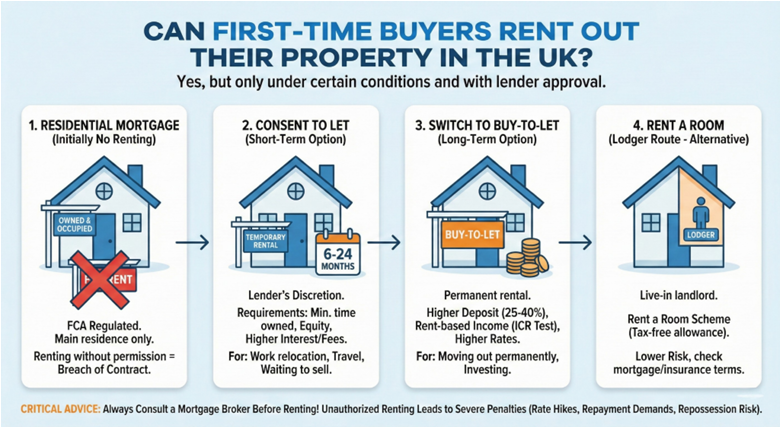
Categories
Finance Solutions

Can a first-time buyer rent out their property in the UK?

Can a First-Time Buyer Rent Out Their Property in the UK?

Understanding Your Options and Legal Requirements

Get Free Consultation
Published by Tapton Capital
2026

Can a First-Time Buyer Rent Out Their Property in the UK?

A first-time purchaser can indeed rent their property out in the UK, but only under certain conditions. This depends on a number of factors, including the type of mortgage, lender approval, regulations, and financial viability.

First-time buyers often purchase a smaller home as a stepping stone to the property ladder. Over time, circumstances change. It may be necessary to move for work, to live with a partner or to travel abroad. Renting out your first home can be a good option in these situations.

Important: Renting is Not Allowed Automatically

Renting is not allowed automatically because the majority of first-time home buyers have a residential mortgage. If you rent without permission, you may be in breach of contract with serious legal and financial consequences.

This guide will explain what you are allowed to do, how lenders evaluate your application, and what routes are available so that you can fully understand the risks before becoming a landowner.

What is a First-Time Buyer Mortgage?

First-time buyers are defined as those who have never owned a property in any part of the world. This includes residential and investment properties. Commercial property, such as an office or shop, does not exclude you.

The Financial Conduct Authority (FCA) regulates residential mortgages. The regulation is in place because the loan will be used for owner-occupation and not to generate rental income.

Key Characteristics of First-Time Buyer Mortgages

  • Minimum deposits can start as low as 5-10%
  • Credit checks and full affordability
  • You must own the property as your main or only residence

By signing the mortgage contract, you agree to not rent out the property without the lender's approval.

Can You Rent Out Your First Home While It's Still Mortgaged?

It is Possible, But Not Automatically

You must modify the terms of the mortgage if your home is still under residential financing. You can do this in four different ways:

1

Get a Consent to Rent

Temporary permission from your lender to rent out your property without switching mortgage types.

2

Change to a Buy-to-Let Mortgage

Switch your residential mortgage to a buy-to-let mortgage for long-term rental arrangements.

3

Remortgage to a New Lender

Move your mortgage to a different lender that offers buy-to-let products.

4

Rent the Property in Part (Lodger's Route)

Take in a lodger while you still live in the property - this usually doesn't require consent to let.

Each option has a different level of risk, cost and lender scrutiny.

Residential Mortgage vs. Buy-to-Let Mortgage

Residential Mortgage (Buy to Live)

Residential mortgages are designed for those who own and live in their property. It is:

  • FCA regulated
  • Based on your personal income
  • Buy-to-let offers lower interest rates than traditional buy-to-let
  • Not intended for rental profits

Renting without permission can be considered as a change in risk.

Buy-to-Let Mortgage

Buy-to-let mortgages are designed to finance rental property and are assessed differently.

  • Interest rates and fees are increasing
  • Deposits range from 25% to 40%
  • Rent, not salary, is the basis for calculating your income
  • The loan-to-value (LTV) test and the interest coverage ratio (ICR) test apply

Most buy-to-let mortgage lenders usually require the rental income to be at least 125% of the monthly interest-only repayment.

Is it Possible to Rent Out a Property That Has a Residential Mortgage?

No, Not Without the Approval of the Lender

Renting out your house without:

  • Consent to Let, or
  • Buy-to-let mortgage

You have breached the mortgage contract.

Possible Consequences Include:

  • Interest rate increases retroactively
  • Immediate repayment demands
  • Refusal to accept future mortgage products
  • Repossession is only possible in extreme cases

What is Consent to Lease?

A consent-to-let agreement is a written, formal agreement that your lender provides, allowing you to rent out a residential home temporarily without switching to a buy-to-let mortgage.

This is a common expression used by:

  • Accidental landlords
  • Short-term relocation of homeowners
  • People who are waiting to sell their home or remortgage
  • Borrowers who work abroad

The mortgage type is not changed by consent to let, only the occupancy rights.

How Lenders Evaluate Consent to Lease Applications

There is no universally accepted approval criterion. The decision to rent is completely discretionary.

Lenders Typically Evaluate:

  • Duration of time with lender (usually minimum 6-12 months)
  • Mortgage Payment History
  • Equity Level (often 20-25%+)
  • Renting for a reason
  • Expected rental income
  • Terms of the Tenancy Agreement
  • Insurance Compliance

A lender may refuse consent even if the criteria are met. This is because it changes the original agreement.

Consent can be granted for 6-24 months, and restrictions may apply:

  • Tenant numbers
  • Rent level
  • Property Use

Costs Associated with Consent to Lease

The cost of a mortgage varies depending on the lender and product but can include:

Potential Costs

  • Interest rate loading (typically +1-3%)
  • Fee for consent (£150 - £300)
  • Administrative fees
  • Landlord Insurance (£170-£200 annually)
  • Tax on rental income (after allowance of £1,000)

Rental income must be declared by self-assessment.

Consent to let: Risks and Rewards

Benefits

  • Paying two mortgages is not necessary
  • Short-term flexibility
  • The existing mortgage structure is retained
  • Tests to determine if a landlord is suitable

Disadvantages

  • Interest rates on higher loans
  • Approval time-limited
  • Tenant void risk
  • Legal responsibility for the landlord

Switching from a Buy-to-Let Mortgage

Lenders usually require that you switch to a buy-to-let mortgage if you intend to rent out your property for a long time.

This is often the case when:

  • Purchase of a new primary residence
  • Move in with your partner
  • Renting for an indefinite period
  • The consent to let is refused

Buy-to-Let Lending Metrics

Lender's Assessment Criteria:

  • LTV - maximum 75%
  • Rent should be less than or equal to a 125% interest coverage ratio (ICR)
  • First-time landlord risk profile

First-time landlords face higher risks, which means stricter criteria for them and higher deposits.

The Costs of Switching from Buy-to-Let to Rent-to-Own

Other costs include:

  • Early repayment charges
  • Valuer or surveyor fees
  • Stamp duty rates increase
  • Licence fees (where applicable)
  • Costs of maintenance and compliance
  • Capital Gains Tax (CGT) on Sale

Alternative Option: Renting Rooms (Lodger Route)

You May Be Able To:

  • You can take in a guest
  • Rent a Room Scheme: Earn rental income
  • Avoid consenting to a remortgage or letting

Renting is the most risk-free option, but it depends on your mortgage and insurance terms.

What Happens If You Rent Without Telling Your Lender?

Renting Without Prior Approval is a Breach of Contract

Lenders may:

  • Interest Rate Increase
  • Refunds are due immediately
  • Refuse to remortgage
  • Start repossession proceedings

Final Summary: Can First-Time Home Buyers Rent Their Property Out?

Yes, But Only If You Use the Correct Structure

  • Short-term rental - Consent to Let
  • Long-term renting - Buy-to-let mortgage
  • Lodging on property - A good option for those who want to live in a home

Before making any changes, it is best to consult a mortgage specialist. Lender criteria can vary greatly, and making the wrong choice could be expensive.

If you do it right, renting your first house can be a great way to make money.

FAQs

Can a UK first-time home buyer rent their property legally?

Yes, first-time buyers can rent their property out legally, but only with permission from the mortgage lender. The majority of first-time home buyers have residential mortgages, which do not permit renting. To rent out your property, you must obtain consent or switch to a mortgage for buy-to-let.

What happens if you rent out your property without notifying your lender?

A mortgage contract is breached if you rent out your property without the lender's approval. The lender can:

  • Reverse your interest rate increase
  • Require immediate repayment of the loan
  • Reject future mortgage products
  • In serious cases, begin repossession proceedings

Your home insurance can be invalidated as well.

Does the lender guarantee my consent to let if I meet their criteria?

No. The consent to let is discretionary even if all requirements are met. Lenders are entitled to refuse consent if they feel renting will change the risk profile for the loan.

How long is the average duration of a consent to let?

Consent to Let is usually granted for 6-24 months. This is a short-term solution and not a long-term rental agreement. Most lenders will insist that you get a buy-to-let mortgage if you plan to rent for an indefinite period of time.

How much will my mortgage payment increase if I consent to let out?

Often, yes. Most lenders will add a rate loading between 1% and 3% to your current residential rate. Some lenders will also charge an administration fee.

What is the difference between a consent-to-let mortgage and a buy-to-let mortgage?

Consent to Let allows you to rent out your home temporarily while still keeping your mortgage. Buy-to-let mortgages are designed for long-term rentals and assessed on rental revenue, loan-to-value (LTV), and interest coverage ratio (ICR), instead of your salary.

What is the minimum rent I must pay to qualify for a buy-to-let mortgage?

Most buy-to-let lenders require that rental income covers at least 125% of the mortgage interest-only payment. The interest coverage ratio (ICR) is used to make sure that the mortgage payment is affordable even if rates increase.

First-time landlords can easily switch from buy-to-let to buy-to-let?

Stricter criteria are often faced by first-time landlords. Lenders may require:

  • Deposits (often up to 40%-75% LTV)
  • Rents are in high demand
  • Credit history

A specialist mortgage broker will improve your chances of approval.

Do I need to have landlord insurance when I rent my first house?

Yes. Once tenants move in, standard home insurance is usually invalid. You will need insurance to cover property damage, liability, and lost rent.

What is the tax rate on my rental income?

Yes. If you are renting out your property, the rental income is taxable. You must declare it via self-assessment. The first £1,000 may be exempt from tax under the Allowance for Property Income. However, anything above that is taxable according to your marginal rate.

Can I rent a single room rather than the entire property?

You can take on a tenant if you are still living at the property. This does usually not need consent to let, and you may be able to qualify for the Rent a Room Scheme.

What are my legal responsibilities as a landowner?

You must follow the following rules, even if you are a new landlord:

  • Gas and electrical safety regulations
  • Energy Performance Certificates (EPC) are required
  • Tenant deposit protection schemes
  • Local licensing rules

If you do not comply, you may be fined or face legal action.

Can I restrict who I can rent my property to?

Yes. Some lenders restrict:

  • Number of tenants
  • Tenancy agreements can be classified into two types: Type A and Type B
  • Rent level

These conditions are usually written in the consent-to-let agreement.

How can I rent out my home in the safest possible way?

It is best to talk to your mortgage broker and to your lender prior to renting. This will ensure:

  • Your contract compliance is important
  • Choose the right mortgage route
  • Avoid costly mistakes
Is renting out my first house a good strategy for the long term?

You can, but only if your rental income is sufficient to cover the costs and risks. Before committing to a long-term investment, it is important to carefully consider factors such as maintenance, taxes, mortgage rates, and void periods.

Need Help Renting Out Your First Property?

Let Tapton Capital help you navigate the process of renting out your first property. Our specialist team can provide expert advice on consent to let, buy-to-let mortgages, and help you understand all your options and legal requirements.

Get Free Consultation Call Now
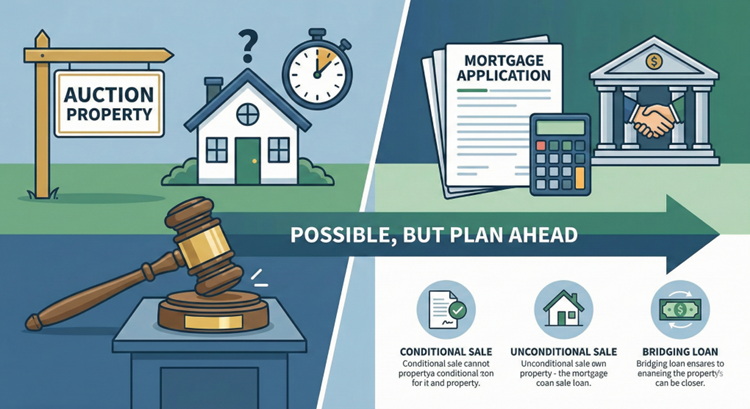
Categories
Finance Solutions

Can you mortgage an auction property? (Fast Finance)

Can You Mortgage an Auction Property?

Fast Finance

Get Free Consultation
Published by Tapton Capital
2026

Can You Mortgage an Auction Property? (Fast Finance)

Property auctions are becoming more popular in the UK as people look to buy or sell homes. Most buyers use a mortgage because rising house prices make it difficult to get on the property ladder. It is a natural question to ask: Can you mortgage an auctioned property?

Yes, It Is Possible

Yes, it is possible to obtain a mortgage for a property purchased at auction. However, there are more risks, stricter criteria and tighter deadlines compared with buying via an estate agent.

Auctions are time-sensitive and legally binding, so buyers need to plan their finances well in advance. Auction properties are often sold below market value and can be a great option for homebuyers as well as investors.

We will explore below the important caveats and lender requirements as well as the types of auction sales, financing options, and frequently asked questions that you should understand before bidding.

What Makes an Auction Property Non-Mortgageable?

Not all auction properties can be mortgaged, even though they range from fully renovated homes to ready-to-move-in houses. Mortgage lenders have strict criteria in place to minimise their risk. If a property does not meet these standards, they may refuse to offer a mortgage.

In general, a property must be immediately liveable. Lenders will not lend if the property does not have a working kitchen or bathroom. Lenders are also unlikely to loan money if a property has serious defects or poses environmental risks.

Common Factors That Prevent a Property From Being Mortgaged

  • Building defects or structural issues
  • Dry rot or wet rot of the structure
  • Japanese Knotweed is an invasive plant species
  • Property near landfills, mining sites or flood zones
  • Short-term leasehold properties, typically under 70 years
  • Buildings or properties in partial disrepair
  • Constructions that are not standard, such as concrete or timber frames

Investors may find that properties with tenants in place are not mortgageable depending on the lender's policy and the tenancy agreement.

How to Buy a House at Auction with a Mortgage

The strict deadlines for completing a purchase at an auction differ from traditional purchases. Understanding the difference between unconditional and conditional auction sales is crucial.

Unconditional Auction Sales

You can also auction off items at a fixed price.

  • The deposit of 10% is payable immediately upon the fall of the hammer
  • The sale becomes legally binding
  • Usually, completion is required within 28-30 days

If you fail to complete the transaction, your deposit may be forfeited, and there is a possibility of legal action.

Important Note

Due to the lengthy time it takes for mortgages, auctions that are unconditional are better suited for cash buyers.

Conditional Auction Sales

The conditional auction provides more flexibility to mortgage buyers.

  • Instead of paying a deposit, a reservation fee is charged
  • An exclusive 60-day period of exclusivity is granted
  • During this period, the seller is not able to accept any other offers

This time extension allows the buyer to complete their legal and mortgage checks, as well as conduct surveys. But, if you don't complete the transaction within this exclusivity period, there are still financial penalties.

What Happens If the Lender Cannot Meet the Deadline?

Buyers can use a bridge loan to solve a problem if a lender is unable to release funds on time. Bridging finance is available in 10 days or less, which makes it ideal for auction purchases.

Bridging Finance Considerations

Bridging loans, however, have higher rates of interest and should only ever be used for a short time. Most buyers remortgage to a standard loan once their property is fully mortgageable.

Bidding Risk and Lender Valuations

Mortgage lenders base their decision to lend on an official valuation and not the purchase price at auction. If the winning bid is higher than the lender's appraisal, the buyer will have to cover the difference.

Avoid Emotional Bidding

It is important to avoid emotional bidding and set a strict bid limit at auction.

What Are the Other Costs to Consider?

Buyers must also budget for:

Additional Costs

  • Legal fees and solicitors
  • Costs of valuation and survey
  • Stamp Duty Land Tax
  • Auction administration fees
  • The legal pack lists costs or obligations

Professionals with experience in auction transactions will reduce the risks of missed liabilities or delays.

Can a Bank Cancel Their Mortgage Offer?

It is rare, but lenders may withdraw a loan offer during the final underwriting process if they identify new risks. It may happen if surveys uncover defects, valuation problems arise or credit checks are changed.

Reducing the Risk

This risk can be reduced by working with auction mortgage brokers who assess the property and the borrower early.

Can You Obtain a Mortgage for a Property That Is Being Renovated?

To qualify for a loan, a property that has undergone renovations must be habitable. A property that needs structural repairs or lacks basic amenities is usually not mortgageable.

Alternative Financing for Renovation Properties

In these cases, the buyer may use commercial financing or cash to finish renovations before remortgaging on a standard loan.

FAQs (Frequently Asked Questions)

Can first-time buyers mortgage an auction property?

First-time buyers are allowed to mortgage auction properties, but there is a greater risk because of the tight deadlines and lender requirements. It is highly recommended that you seek professional advice.

Do all banks offer mortgages on auction properties?

Not all banks will lend for auction purchases. Many buyers work with specialist lenders, who understand the auction timelines and risks.

Do I need a mortgage principle before bidding on a property?

Although it is not required by law, having a mortgage agreement in principle is highly recommendable. This helps to confirm affordability and accelerates the application process.

What happens if you win an auction but are unable to get a mortgage loan?

You may be forced to pay a reservation fee or lose your deposit if you are unable to secure a mortgage on time. As a last resort, bridging finance can be used.

Can I get a mortgage to buy an auction house?

The property must meet the criteria of the lender and be suitable for renting. Some lenders require landlord experience.

Do auction properties always sell for less than the market value?

Not always. Competitive bidding can drive prices higher, even if some sellers sell below the market value. Lenders still will rely on the lender's valuation and not the auction price.

I won an auction. Can I get a mortgage?

This is possible, but it's risky. To avoid missing deadlines, it is best to start the finance arrangements before bidding.

What is the difference between unconditional and conditional auction sales?

Unconditional sales require a 10% deposit immediately and completion within 28-30 days, making them better for cash buyers. Conditional sales charge a reservation fee and provide a 60-day exclusivity period, giving mortgage buyers time to complete checks and secure financing.

How long does it take to get a mortgage for an auction property?

Standard mortgages typically take 4-8 weeks, which is often too long for unconditional auctions (28-30 days). This is why many buyers use bridging finance (available in 10 days or less) or opt for conditional auctions with a 60-day exclusivity period.

Conclusion

Can you buy an auction property with a mortgage? Yes, you can, but your success will depend on how well you understand the auction terms, lender requirements, valuation limits and timelines.

With the right preparation, expert advice and a realistic budget, purchasing an auction property using a mortgage is both possible and rewarding.

Need Fast Finance for an Auction Property?

Let Tapton Capital help you secure the right financing for your auction property purchase. Our specialist team understands auction timelines and can provide bridging finance, mortgage advice, and expert guidance to help you complete your purchase successfully.

Get Free Consultation Call Now
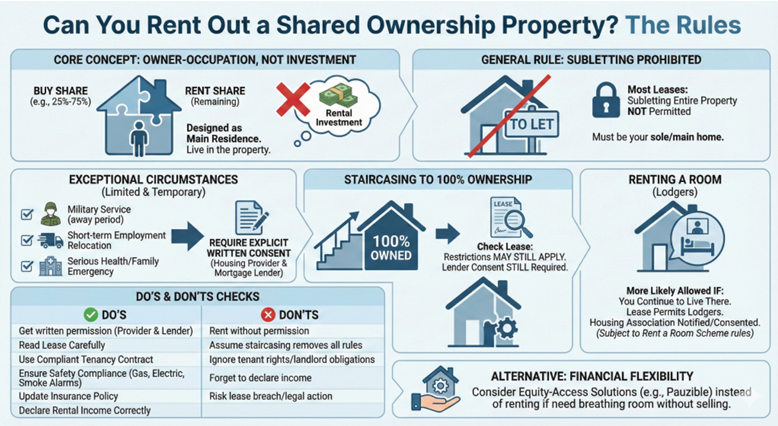
Categories
Finance Solutions

Can You Rent Out a Shared Ownership Property? The Rules

Can You Rent Out a Shared Ownership Property?

The Rules

Get Free Consultation
Published by Tapton Capital
2026

Can You Rent Out a Shared Ownership Property? The Rules

Shared ownership homes are a way for those who can't afford to purchase a home outright to become homeowners. These homes are not designed for investment but rather to be occupied by the owner. Therefore, they are subject to strict legal and contract restrictions on renting.

Before considering subletting, it is important to understand how shared ownership works and what your lease allows.

What is a Shared-Ownership Property?

Shared ownership properties allow you to purchase a portion of the home and rent the remainder.

Key Features of Shared Ownership

  • Typically, you buy 25% to 75% of a property
  • Some schemes, particularly the newer ones, allow you to begin with as little as a 10% ownership stake
  • The housing association, local authorities, or registered private providers own the remaining shares
  • Rent is paid on the part you own, not the share owned by the landlord

Important Restriction

Renting is only permitted if the property is your main or sole residence.

What is Shared Ownership?

1

Initial Purchase

For a buyer to be eligible for a shared-ownership property, the criteria must be met by both the housing provider and government.

The following are the most important requirements:

  • Household income of not more than £80,000 or £90,000
  • Unable to afford to purchase a suitable house outright
  • You are a first-time buyer or former owner who cannot afford to purchase
  • Purchase an initial share between 10% and 75%
  • A deposit of 5%-10% is required to buy a share
  • Take out a mortgage for shared ownership with a lender that is approved
2

Rent Payments

Rent is charged on the part of the property that you don't own.

  • For new shared ownership properties, the rent charged in the first year is capped at 3% of the value of the owner's share
  • Rent is usually set at around 2.5%
  • Rental reviews are usually conducted annually
  • Rent increases are typically tied to inflation, such as CPI, RPI, or CPI plus 0.5%, depending on the terms of the lease

Rent is one of the most important features of shared ownership. It is strictly regulated.

3

Staircasing

Staircasing is a way for shared homeowners to purchase additional shares over time.

  • 10% is the usual increment for additional shares
  • Each new share's price is determined by the current market value, which is typically performed by an RICS-qualified surveyor
  • Some schemes offer 1% per year extra for shared ownership leases that begin after April 1, 2021
  • Rents decrease proportionally as your property increases
4

Own a Full Ownership

You will have 100% ownership once you have reached the following:

  • Rent is no longer payable to housing associations
  • The property is yours, but you may still be liable for any mortgage
  • Renting is not always automatic for some shared ownership leases, as they still have ongoing restrictions

Even after staircasing, it is important to check the lease.

Can You Rent Out a Property That Is Part of a Shared Ownership?

Shared ownership is designed to allow people to live in their own homes and not as a rental investment.

As a Consequence:

  • Subletting is prohibited in most shared ownership leases
  • Your main residence must be the property
  • Renting the entire property is not permitted

There are some exceptions, but they are very limited.

Renting Out the Entire Property

You cannot in most cases rent out an entire property without explicit written consent.

Exceptional Circumstances

In exceptional circumstances such as:

  • You must live somewhere else for a certain period of time if you are in military service
  • Short-term employment relocation
  • Health or family emergencies that are serious

Even then:

  • Permissions are usually limited in time
  • Lease conditions must be adhered to
  • You must also get written permission from your mortgage lender if you have one

Renting Is Possible If You Own the Entire Property

  • Even after staircasing, some leases still have restrictions
  • The consent of the mortgage lender is still required

When You Get Permission to Rent Out

You must make sure that the following is in place:

1

Tenant Reference

Tenant reference to confirm suitability

2

Comprehensive Tenancy Contract

Rent, duration, legal obligations, and responsibilities are all covered in a comprehensive tenancy contract

3

Landlord Insurance

Standard home insurance is not the best choice for landlord insurance

4

UK Rental Regulations Compliance

All UK rental regulations, including:

  • Gas Safety Certificates
  • Electrical Safety Reports
  • Smoke and Carbon Monoxide Alarms
  • Right to Rent Checks

Tax-Deductible Rental Income

How to declare it correctly - ensure you understand your tax obligations when renting out a shared ownership property.

Renting Out a Room in a Shared Ownership Property

Renting out a spare bedroom may be allowed in some circumstances.

It is more likely that:

  • Continue to live on the property
  • Leases allow lodgers to stay in the property
  • You have notified or obtained consent from your housing association

Rent a Room Scheme

You may be able to use the Rent a Room Scheme if you are allowed to do so, but only if HMRC's rules allow it.

The Do's and Don'ts of Subletting Shared Ownership Homes

The Do's

  • Always get written permission from your housing association
  • Be sure to read your lease contract carefully
  • Obtain mortgage lender consent before renting
  • Renters must be properly referred
  • Use a tenancy contract that is legally compliant
  • Safety and regulatory compliance is essential
  • Your insurance policy should be updated

The Don'ts

  • Rent out your property only with permission
  • Do not assume that staircasing removes all restrictions
  • Tenant rights and landlord obligations are important
  • Don't forget to declare rental income
  • Breach of your lease can result in legal action or forced sale

Alternatives If You Need Financial Flexibility

Some homeowners look for alternatives, such as equity-access solutions, if renting isn't an option and selling isn't their preferred choice.

Equity Release Solutions

Pauzible, for example, offers ways to unlock your home equity without having to sell or take on conventional debt. This can give you financial breathing room during tough times while still allowing for compliance with the rules of shared ownership.

Frequently Asked Questions

Can I rent my property out?

No. You have to live in the house unless both your mortgage lender and the housing association give you written permission.

Do you have any exceptions to the rule?

You can, but only under exceptional circumstances such as military service, short-term employment relocation, or serious health or family emergencies. Even then, permissions are usually limited in time and require written consent.

What is staircasing, and how does this affect rental?

Staircasing is like buying more shares of your home. Some leases restrict renting even if you own your home 100%. It's important to check your lease even after achieving full ownership through staircasing.

Can I rent a room out?

You can if your lease permits it and you plan to continue living in the house. You may need to notify or obtain consent from your housing association, and you may be able to use the Rent a Room Scheme if HMRC's rules allow it.

What happens if you rent without permission?

You could be forced to sell your shares if you breach your lease. This can result in legal action, financial penalties, and potentially losing your shared ownership property.

What are the income requirements for shared ownership?

Household income must be not more than £80,000 or £90,000 depending on the location and scheme. You must also be unable to afford to purchase a suitable house outright.

How much rent do I pay on the share I don't own?

For new shared ownership properties, the rent charged in the first year is capped at 3% of the value of the owner's share. Rent is usually set at around 2.5% and rental reviews are usually conducted annually, with increases typically tied to inflation.

Can I buy more shares after my initial purchase?

Yes, through a process called staircasing. You can usually buy additional shares in 10% increments, or 1% per year for leases beginning after April 1, 2021. Each new share's price is determined by the current market value assessed by an RICS-qualified surveyor.

Conclusion

Shared ownership was designed to make home ownership affordable and not to encourage buy-to-let. Renting out shared ownership homes is generally prohibited, strictly regulated and only permitted in rare circumstances.

Understanding your lease and seeking permission early can help you protect your home as well as your financial situation.

Need Help with Shared Ownership Property Financing?

Let Tapton Capital help you navigate the complexities of shared ownership property financing. Our specialist team can assist with understanding your lease terms, securing appropriate financing, and ensuring compliance with all legal requirements.

Get Free Consultation Call Now
×