Categories
Finance Solutions

Renting out a leasehold property in the UK? Checking Your Lease

Renting Out a Leasehold Property in the UK?

Checking Your Lease

Get Free Consultation
Published by Tapton Capital
2026

Renting Out a Leasehold Property in the UK? Checking Your Lease

The process of renting out your property on a UK leasehold basis can be complicated if you are a UK leasehold landlord. It is possible to rent a leasehold home, but the legal right depends on the terms and conditions of the lease, as well as compliance with mortgage, insurance and other statutory requirements.

This guide answers the question that most leaseholders have: Can you rent out your leasehold property?

Understanding Leasehold Properties

Leasehold is a form of long-term property ownership in which the owner purchases the right to use a property over a set number of years. The typical lease term ranges from 99 to 125 years. However, some leases may last for up to 999 years.

The leaseholder can extend the lease, but the ownership will revert to the freeholder when the lease expires.

The Length of a Lease and Its Importance

High-risk leases include those that are less than 80 years old or have a shorter term. These properties are at high risk.

High-Risk Lease Characteristics

  • Mortgages are harder to get.
  • Often attract higher extension costs
  • May reduce resale value

This is important for landlords, as mortgage eligibility directly impacts the ability to lease out a leasehold home.

Ownership Structure

Leaseholders own their property, but not the land underneath or the larger building structure. The leaseholder retains the ownership of the land, and the freeholder has enforcement rights under the lease.

Understanding the Key Terms of Leasehold

Understanding the legal and financial aspects of renting out a leasehold home is essential.

Lease Agreement

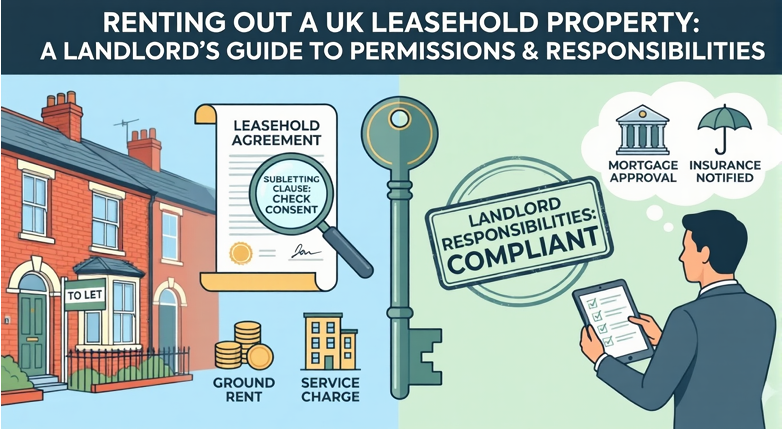
Lease agreements are legally binding contracts that define leaseholders' rights, the rights of the freeholder, and property uses permitted and prohibited. The lease agreement will determine whether you are able to rent out the property.

Subletting Clauses in Leases

The majority of leases include at least one of the following:

1

Subletting Prohibited

Subletting is prohibited in all circumstances.

2

Qualified Covenant

Subletting with the consent of the freeholder is permitted under a qualified covenant.

3

Unrestricted Subletting

Subletting without consent is allowed.

Important Note

Even if there is no restriction, it's best to notify the freeholder or managing agents. The freeholder can take legal action if a tenant sublets without permission.

Ground Rent

The leaseholder pays the ground rent to the freeholder separately from the service charge.

The Characteristics Of Ground Rent

  • Payments are made annually (or according to the lease)
  • The amount is stated in the lease
  • Include clauses that increase ground rent
  • The amount can range from a nominal amount to several hundred pounds per annum

The leaseholder pays ground rent.

Ground Rent Terms for Freeholders

A breach of the lease can be caused by failure to pay ground rent. This could affect your ability to rent out your property.

Service Charges

The leaseholder pays service charges to maintain and manage the building.

What Service Charges Typically Cover

  • Cleaning communal areas
  • Lift Maintenance
  • Garden upkeep
  • Building repairs
  • Window Cleaning

Service charges must:

  • Charged strictly according to the lease
  • Be incurred in a reasonable manner, as required by the law

Charges for Freeholder or Managing Agent

Unpaid service fees can restrict the consent to sublet and escalate into legal disputes.

Subletting a Leasehold Property

Subletting a leasehold property means renting out the entire property, typically under an assured shorthold tenancy.

Subletting is only permitted if the lease allows it.

Subletting vs Taking in a Lodger

This is a crucial distinction:

Feature Subletting Taking in a Lodger
Tenant Status The tenant is in exclusive possession Leaseholder remains in residence
Lease Restrictions Subletting is not always allowed in leases Lodgers may be allowed even if subletting is prohibited
Verification Required Verify this in the lease Verify this in the lease

Important Documents to Check Before Renting Out

You must carefully review the documents below before renting out a property.

1

Lease Agreement

The lease takes precedence over all other agreements. The lease is legally preceding, even if your tenancy contract allows subletting.

Tenancy agreement - Lease - Overrides

2

Mortgage Agreement

If you bought the property with a loan:

  • Some lenders require that you obtain consent before you can let.
  • Some mortgages prohibit letting entirely.
  • Infringement of mortgage terms may lead to enforcement action.
3

Insurance Agreement

Once a home is rented, the standard residential insurance policy is usually invalid. Subletting can invalidate your insurance policy.

You may need:

  • Landlord Insurance
  • Building insurance updated

If you do not update your insurance, you may be exposed to uninsured loss.

Legal Risks for Renting without Permission

A lease is breached if you rent out a property that's leasehold without the required consent.

Consequences

  • Formal breach notices
  • Legal Costs
  • Mortgage Fraud
  • Insurance cover that is invalid
  • In extreme situations, forfeiture or repossession may be required

If lease breaches are persistent and serious, the freeholder can take possession of the property.

Legal Responsibilities of a Leasehold Owner

You are now responsible for the entire property. They are governed, among other things, by:

  • Landlord Tenant Act 1985
  • Regulations on housing health and safety

The landlord must comply with the Landlord and Tenant Act, 1985.

You Must:

  • Property safety regulations
  • Service Charges for Fair Treatment
  • Tenancy agreements that are legally sound

Tenancy Agreements & Lease Alignment

Your lease agreement must:

  • Lease restrictions
  • Prohibit prohibited uses (e.g., short lets if banned)
  • Don't give away rights that you don't legally own

Lease terms must be included in the tenancy agreement.

FAQs (Frequently Asked Questions)

Can you rent a leasehold home in the UK?

In most cases, yes. The lease agreement will determine whether sublettings are allowed or if freeholder approval is needed before renting the property out.

Subletting a leasehold property: Do I need permission?

Often, yes. Many leases include a clause that stipulates the leaseholder must obtain the written consent of the freeholder prior to subletting. The consent must be obtained in writing and not withheld unreasonably.

What happens if you rent out your leasehold property without permission?

A breach of the lease is renting without consent. The freeholder can take enforcement actions, including legal fees, formal breach notifications, and, in severe cases, repossession of the property or forfeiture.

What impact does ground rent or service charge have on my ability to let out a property?

Yes. Leaseholders can be in breach of their lease if they do not pay ground rent or service fees. If there are outstanding charges, freeholders may not consent to a sublet. Arrears could escalate into a legal dispute.

Subletting a leasehold is the same thing as taking in a tenant?

No. Subletting gives exclusive possession to the tenant. Taking in a lodger is the same as the leaseholder living in the home. Subletting is prohibited in some leases, but lodgers are allowed. Therefore, it's important to check the wording of your lease.

Do I have to get my mortgage lender's permission before renting out a leasehold home?

If the property has been mortgaged, then yes. In most residential mortgage agreements, consent is required to rent out the property. Lending without approval of the lender can lead to mortgage breach terms and enforcement actions.

Can I still get insurance if I rent out the leasehold property that I own?

Not always. Subletting may invalidate standard residential insurance policies. Most leaseholders need landlord insurance, and they may also need to update their building insurance.

Is the Landlord and Tenant Act of 1985 applicable to leasehold landlords as well?

Yes. You are a legal landlord once you rent out a property. This includes obligations related to property conditions, service charges and tenant rights.

Can a lease be overridden by a tenancy contract?

No. Tenancy agreements must be in line with lease conditions and cannot grant leaseholders rights they do not have.

Can you rent out your leasehold property for short periods?

No. Lease agreements often restrict or prohibit short-term or vacation rentals. Even if short-term renting is allowed, mortgage conditions and planning regulations may restrict it.

Conclusion

Renting out a UK leasehold property is possible but not automatic. The lease agreement must be carefully reviewed, as it is the key document.

Leaseholders are required to:

  • Check the subletting clauses
  • Understanding ground rent and service charge
  • Where required, obtain the consent of freeholders
  • Mortgage and insurance approval secured
  • Obligations of a landlord

Subletting without consent can have serious financial and legal consequences, including repossession. It is important to make informed and compliant decisions in order to protect both your rental income and your long-term interest.

Need Help with Leasehold Property Financing?

Let Tapton Capital help you navigate the complexities of leasehold property ownership and financing. Our specialist team can assist with understanding your lease terms, securing appropriate financing, and ensuring compliance with all legal requirements.

Get Free Consultation Call Now


Categories
Finance Solutions

Can You Get a Mortgage for Land? Financing Options Explained

Can You Get a Mortgage for Land?

Financing Options Explained

Get Free Consultation
Published by Tapton Capital
2026

Can You Get a Mortgage for Land? Financing Options Explained

Land mortgages are secured against land plots, not completed residential properties. In a residential mortgage standard, the security provided by the lender is a habitable home with a well-established resale marketplace. Land is not the primary consideration.

When borrowing to purchase land, however, the land itself is the only security. This fundamentally alters how lenders evaluate risk, value and affordability.

What is a Land Mortgage?

Land mortgages are considered higher-risk investments by lenders because:

  • Rental income is not generated by land.
  • Resale of land is slower and less predictable.
  • Planning permission has a major impact on the value of land.

Land mortgages are therefore not offered widely by mainstream lenders but are instead provided by land and development finance specialists.

Important Note

Many standard lenders will not finance land and advise borrowers to use a mortgage broker who is experienced in land transactions.

Can You Get a Mortgage for Land?

You can obtain a mortgage in the UK for land, but it is entirely dependent on:

Key Factors

  • Land types
  • The intended use
  • The current planning status
  • The borrower's financial profile

Land mortgages have a specific purpose, unlike residential mortgages. The borrower will need to clearly state why and how the land will be used.

By reducing the uncertainty of their future land use, borrowers can reassure lenders.

How Land Mortgages Differ from Residential Mortgages

Feature Residential Mortgage Land Mortgage
Security Completed home Undeveloped land
Risk level Lower Higher
Deposit As low as 5% Usually 30–50%
Interest rates Lower Higher
Resale market Liquid Illiquid
Planning dependency None High

Higher risk leads to higher interest rates and lower loan-to-value ratios.

What Types of Land Are Available, and What Is Their Impact on Mortgage Approval?

Local Planning Authorities (LPAs), in the UK, tightly regulate any change in use.

Residential Building Plots

The most attractive mortgages are those with land that has been approved for residential development, either in outline or fully. Planning permission can reduce lender risk and improve valuation certainty. It also increases the maximum LTV.

Agricultural Land

Agri-land is usually financed by agricultural mortgages, and it is often tied to farming income, business expansion, and land investment for the long term. Lenders evaluate agricultural land on the basis of its use, income, and planning restrictions.

Woodland and Forestry Land

Woodland mortgages are a type of agricultural lending. Although woodland is rarely permitted for development, lenders will still consider it when the rights of access are clearly defined, environmental restrictions are well understood, and ownership intent for the long-term is shown.

Commercial Development Land

As part of an overall business strategy, commercial development mortgages may be issued. Lenders will require a detailed plan of business, financial projections and proof that the planning is feasible.

What Is the Role of Planning Permission in Land Mortgages?

The approval of a land mortgage is heavily influenced by the planning permission.

1

Full Planning Permission

At the lowest lender risk. This provides the most certainty and typically results in better loan terms.

2

Outline Planning Permission

Moderate risk. Some uncertainty remains, but the basic development is approved.

3

No Planning Permission

High risk. If you don't have planning permission, your LTV offer will be lower and interest rates higher.

Lenders will also evaluate:

  • Change of Land Use Permission
  • Local planning authority history
  • Environmental and zoning regulations

Self-Build Mortgages Explained

Self-build mortgages combine:

  • Land mortgage
  • Construction mortgage

Self-build mortgages are released in stages, also known as stage payments, unlike traditional mortgages.

The Typical Stage Release Structure

1

Land Purchase

2

The Foundations

3

Structure Build

4

Weatherproof Stage

5

Completion

Stage-based financing reduces the lender's exposure and aligns funding with construction progress.

Land Mortgage Criteria: What Lenders Look For

The LTV and the Deposit

The maximum LTV for most land mortgages is 65-70%.

LTV Factors

  • Land with planning = higher LTV
  • Land without planning = lower LTV

Deposits can come from:

  • First-time buyer discounts (especially for those who are first-time buyers)
  • Equity Release from Existing Property

Important Warning

If repayments are not met, the home may be repossessed.

Interest Rates

The interest rates on land mortgages are usually higher than those of residential mortgages because:

  • Asset illiquidity
  • Planning Uncertainty
  • Valuation volatility

Pricing is influenced by the competitiveness of specialist lending markets as well as the Bank of England base rate.

Competitive Rates Available

You can get rates as low as 4% with strong planning status, low LTV, and a clear exit strategy.

Credit History and Affordability

Land mortgages are subjected to enhanced stress tests by lenders. They assess:

  • Income Stability
  • Existing debt
  • Credit Score
  • Future affordability

Higher-risk assets require stronger borrower profiles.

Business Plans and Exit Strategies

Lenders require:

  • Formal business plans
  • A clear exit strategy

Exit strategies can include:

  • Refinancing onto a residential mortgage
  • Sales of finished development
  • Long-term income generation

A defined exit path is always required when bridging finance.

Buying Land at Auction and Alternative Financing

Land purchased at auction usually requires:

  • 10% deposit immediately
  • Completion in 28 Days

Due to the long approval process for mortgages, many buyers rely on bridge finance.

Bridge Finance Warning

Bridging loans can be expensive and only last a short time. Financial exposure can be severe if you fail to develop a plan of exit.

Hidden Due Diligence Factors Lenders Assess

Even if it is not explicitly stated, lenders will consider:

Due Diligence Checklist

  • Title Complexity
  • Access and easements
  • Utility availability
  • Floods and environmental risks
  • Soil stability

These hidden factors directly impact the valuation and approval of mortgages.

FAQs

Can I get a mortgage for land without planning permission?

Yes, but it's much more difficult. Without planning permission, you'll face higher interest rates, lower LTV ratios (typically 30-50%), and fewer lender options. It's considered high risk by lenders.

What deposit do I need for a land mortgage?

Most land mortgages require a deposit of 30-50% of the purchase price. The exact amount depends on the planning status, land type, and your financial profile. Land with full planning permission may allow up to 70% LTV.

How long does it take to get a land mortgage approved?

Land mortgage approvals typically take longer than residential mortgages, often 4-8 weeks or more. This is due to the additional due diligence required, including planning checks, valuations, and risk assessments.

Can I use a land mortgage for agricultural land?

Yes, agricultural land can be financed through agricultural mortgages. Lenders will evaluate the land based on its use, income potential, and planning restrictions. These are specialist products typically offered by agricultural finance specialists.

What is the difference between a land mortgage and a self-build mortgage?

A land mortgage only covers the purchase of the land. A self-build mortgage combines land purchase with construction financing, releasing funds in stages as the build progresses. Self-build mortgages are more complex but provide a complete financing solution.

Should I use a mortgage broker for land financing?

Yes, it's highly recommended. Many mainstream lenders don't offer land mortgages, and specialist brokers have access to lenders who specialise in land and development finance. They can significantly improve your approval chances and help you find the best terms.

Conclusion

  • Land mortgages are a specialist financial product.
  • The approval of a planning permit reduces the risk and improves loan terms.
  • Deposit rates and deposits are higher when lenders are exposed.
  • Documentation, exit planning, and a clear intent are all essential.
  • Specialist brokers improve approval rates by a significant margin.

Land mortgages are possible, but only if you manage your risk, define your purpose, and prepare thoroughly.

Need Help Securing Land Financing?

Let Tapton Capital help you navigate the complexities of land mortgages. Our specialist brokers have extensive experience with land and development finance, helping clients secure the right financing for their land purchase or development project.

Get Free Consultation Call Now

Can You Get a Mortgage for Land?

Financing Options Explained

Get Free Consultation
Published by Tapton Capital
2026

Can You Get a Mortgage for Land? Financing Options Explained

Land mortgages are secured against land plots, not completed residential properties. In a residential mortgage standard, the security provided by the lender is a habitable home with a well-established resale marketplace. Land is not the primary consideration.

When borrowing to purchase land, however, the land itself is the only security. This fundamentally alters how lenders evaluate risk, value and affordability.

What is a Land Mortgage?

Land mortgages are considered higher-risk investments by lenders because:

  • Rental income is not generated by land.
  • Resale of land is slower and less predictable.
  • Planning permission has a major impact on the value of land.

Land mortgages are therefore not offered widely by mainstream lenders but are instead provided by land and development finance specialists.

Important Note

Many standard lenders will not finance land and advise borrowers to use a mortgage broker who is experienced in land transactions.

Can You Get a Mortgage for Land?

You can obtain a mortgage in the UK for land, but it is entirely dependent on:

Key Factors

  • Land types
  • The intended use
  • The current planning status
  • The borrower's financial profile

Land mortgages have a specific purpose, unlike residential mortgages. The borrower will need to clearly state why and how the land will be used.

By reducing the uncertainty of their future land use, borrowers can reassure lenders.

How Land Mortgages Differ from Residential Mortgages

Feature Residential Mortgage Land Mortgage
Security Completed home Undeveloped land
Risk level Lower Higher
Deposit As low as 5% Usually 30–50%
Interest rates Lower Higher
Resale market Liquid Illiquid
Planning dependency None High

Higher risk leads to higher interest rates and lower loan-to-value ratios.

What Types of Land Are Available, and What Is Their Impact on Mortgage Approval?

Local Planning Authorities (LPAs), in the UK, tightly regulate any change in use.

Residential Building Plots

The most attractive mortgages are those with land that has been approved for residential development, either in outline or fully. Planning permission can reduce lender risk and improve valuation certainty. It also increases the maximum LTV.

Agricultural Land

Agri-land is usually financed by agricultural mortgages, and it is often tied to farming income, business expansion, and land investment for the long term. Lenders evaluate agricultural land on the basis of its use, income, and planning restrictions.

Woodland and Forestry Land

Woodland mortgages are a type of agricultural lending. Although woodland is rarely permitted for development, lenders will still consider it when the rights of access are clearly defined, environmental restrictions are well understood, and ownership intent for the long-term is shown.

Commercial Development Land

As part of an overall business strategy, commercial development mortgages may be issued. Lenders will require a detailed plan of business, financial projections and proof that the planning is feasible.

What Is the Role of Planning Permission in Land Mortgages?

The approval of a land mortgage is heavily influenced by the planning permission.

1

Full Planning Permission

At the lowest lender risk. This provides the most certainty and typically results in better loan terms.

2

Outline Planning Permission

Moderate risk. Some uncertainty remains, but the basic development is approved.

3

No Planning Permission

High risk. If you don't have planning permission, your LTV offer will be lower and interest rates higher.

Lenders will also evaluate:

  • Change of Land Use Permission
  • Local planning authority history
  • Environmental and zoning regulations

Self-Build Mortgages Explained

Self-build mortgages combine:

  • Land mortgage
  • Construction mortgage

Self-build mortgages are released in stages, also known as stage payments, unlike traditional mortgages.

The Typical Stage Release Structure

1

Land Purchase

2

The Foundations

3

Structure Build

4

Weatherproof Stage

5

Completion

Stage-based financing reduces the lender's exposure and aligns funding with construction progress.

Land Mortgage Criteria: What Lenders Look For

The LTV and the Deposit

The maximum LTV for most land mortgages is 65-70%.

LTV Factors

  • Land with planning = higher LTV
  • Land without planning = lower LTV

Deposits can come from:

  • First-time buyer discounts (especially for those who are first-time buyers)
  • Equity Release from Existing Property

Important Warning

If repayments are not met, the home may be repossessed.

Interest Rates

The interest rates on land mortgages are usually higher than those of residential mortgages because:

  • Asset illiquidity
  • Planning Uncertainty
  • Valuation volatility

Pricing is influenced by the competitiveness of specialist lending markets as well as the Bank of England base rate.

Competitive Rates Available

You can get rates as low as 4% with strong planning status, low LTV, and a clear exit strategy.

Credit History and Affordability

Land mortgages are subjected to enhanced stress tests by lenders. They assess:

  • Income Stability
  • Existing debt
  • Credit Score
  • Future affordability

Higher-risk assets require stronger borrower profiles.

Business Plans and Exit Strategies

Lenders require:

  • Formal business plans
  • A clear exit strategy

Exit strategies can include:

  • Refinancing onto a residential mortgage
  • Sales of finished development
  • Long-term income generation

A defined exit path is always required when bridging finance.

Buying Land at Auction and Alternative Financing

Land purchased at auction usually requires:

  • 10% deposit immediately
  • Completion in 28 Days

Due to the long approval process for mortgages, many buyers rely on bridge finance.

Bridge Finance Warning

Bridging loans can be expensive and only last a short time. Financial exposure can be severe if you fail to develop a plan of exit.

Hidden Due Diligence Factors Lenders Assess

Even if it is not explicitly stated, lenders will consider:

Due Diligence Checklist

  • Title Complexity
  • Access and easements
  • Utility availability
  • Floods and environmental risks
  • Soil stability

These hidden factors directly impact the valuation and approval of mortgages.

FAQs

Can I get a mortgage for land without planning permission?

Yes, but it's much more difficult. Without planning permission, you'll face higher interest rates, lower LTV ratios (typically 30-50%), and fewer lender options. It's considered high risk by lenders.

What deposit do I need for a land mortgage?

Most land mortgages require a deposit of 30-50% of the purchase price. The exact amount depends on the planning status, land type, and your financial profile. Land with full planning permission may allow up to 70% LTV.

How long does it take to get a land mortgage approved?

Land mortgage approvals typically take longer than residential mortgages, often 4-8 weeks or more. This is due to the additional due diligence required, including planning checks, valuations, and risk assessments.

Can I use a land mortgage for agricultural land?

Yes, agricultural land can be financed through agricultural mortgages. Lenders will evaluate the land based on its use, income potential, and planning restrictions. These are specialist products typically offered by agricultural finance specialists.

What is the difference between a land mortgage and a self-build mortgage?

A land mortgage only covers the purchase of the land. A self-build mortgage combines land purchase with construction financing, releasing funds in stages as the build progresses. Self-build mortgages are more complex but provide a complete financing solution.

Should I use a mortgage broker for land financing?

Yes, it's highly recommended. Many mainstream lenders don't offer land mortgages, and specialist brokers have access to lenders who specialise in land and development finance. They can significantly improve your approval chances and help you find the best terms.

Conclusion

  • Land mortgages are a specialist financial product.
  • The approval of a planning permit reduces the risk and improves loan terms.
  • Deposit rates and deposits are higher when lenders are exposed.
  • Documentation, exit planning, and a clear intent are all essential.
  • Specialist brokers improve approval rates by a significant margin.

Land mortgages are possible, but only if you manage your risk, define your purpose, and prepare thoroughly.

Need Help Securing Land Financing?

Let Tapton Capital help you navigate the complexities of land mortgages. Our specialist brokers have extensive experience with land and development finance, helping clients secure the right financing for their land purchase or development project.

Get Free Consultation Call Now
Categories
Finance Solutions

Investor Packs That Raise Capital: What to Include (and What to Remove)

Investor Packs That Raise Capital

What to Include (and What to Remove)

Get Free Consultation
Investor Packs That Raise Capital

Investor Packs That Raise Capital: What to Include (and What to Remove)

Capital raising is not about impressive design or exaggerated returns. A more cautious, informed, and selective investor is expected in 2026. Clear, credible, and structured investor packs distinguish themselves from those that fail to raise capital.

Investor packs are not sales brochures. Documents like this are used to make decisions. A sophisticated investor or lender can trust opportunities presented in this way if you include the right information in an investor pack or remove the wrong information.

What Is an Investor Pack?

Often referred to as an investment memorandum, an investor pack explains:

  • The investment opportunity
  • The financial assumptions
  • The risks and mitigations
  • The exit strategy
  • The capital structure

Investing confidence is its sole purpose.

Capital Raising Failures of Investor Packs

In many investor packs, the deal isn't bad, but the information is presented incorrectly. The following issues are common:

Common Pitfalls

  • Overly optimistic projections
  • Too much marketing language
  • Lack of risk disclosure
  • No clear exit strategy
  • Inconsistent or unclear numbers

Realists prioritise realism over excitement in 2026.

Investor Packs That Raise Capital

1

An Overview of the Investment (Not a Sales Pitch)

Introductions should explain:

  • What the asset is
  • Where it is located
  • Why does it exist as an opportunity?
  • Who it is suitable for

It should be factual, concise, and free of hype.

2

The Deal Structure

Investors need to understand:

  • Total project cost
  • How much capital is required
  • Debt vs equity split
  • Investor position in the capital stack

Ambiguity here is a deal-breaker.

3

Financials That Can Be Defended

Include:

  • Purchase price and costs
  • Rental or income assumptions
  • Operating expenses
  • Conservative return scenarios

Avoid best-case projections. Credible packs show base-case logic.

4

Risk Disclosure (This Builds Trust)

Strong investor packs openly address:

  • Market risks
  • Planning or regulatory risks
  • Cost overruns
  • Exit risks

Transparency increases confidence and reduces friction.

5

A Realistic Exit Strategy

Investors always ask: How can I get my money back?

In your pack, you must clearly explain:

  • The exit route
  • The timing
  • Comparable evidence supporting it

Capital rarely moves without a credible exit.

6

Track Record and Experience

Present your experience clearly. Start by focusing on:

  • Professional advisors
  • Conservative assumptions
  • Structured oversight

Ambition is not as important as credibility.

Investor Packs: What to Remove

Elements to Remove

1. Overused Buzzwords

"Guaranteed returns" or "once-in-a-lifetime opportunities" reduce trust.

2. Unrealistic Growth Projections

Aggressive assumptions signal risk and inexperience.

3. Excessive Design Over Substance

The quality of content is more important than the quality of the presentation.

4. Missing or Vague Exit Plans

Investing in unclarified exits is risky.

Why Professional Structuring Makes the Difference

Capital raisers rarely create investor packs alone. Typically, they are:

  • Finance-led – Reflecting realistic funding assumptions and lender appetites
  • Exit-driven – An exit strategy is aligned with every deal
  • Lender-aligned – Structured in a way that makes sense to investors and developers

Professional support is essential at this point.

Why Tapton Capital Is the Right Partner for Investor Packs

Capital partners and lenders trust Tapton Capital's deals because we structure them in a way that makes sense to investors and developers.

Tapton Capital Adds Value

Finance-Led Structuring

Investor packs reflect realistic funding assumptions and lender appetites.

Exit-Focused Analysis

An exit strategy is aligned with every deal.

Credibility With Capital Partners

Logic-based investor packs are taken seriously.

Support for Complex Deals

Complexity is addressed – not hidden.

Are Investor Packs Right for Me?

The investor pack is essential for:

Property Developers Raising Equity

Professional structuring for property development projects seeking equity investment.

Joint Venture Partnerships

Clear documentation for JV equity deals and partnership structures.

Specialist Asset Investments

Structured presentations for unique or specialist property investments.

High-Value Acquisitions

Professional investor packs for significant property acquisitions requiring capital.

Professional and institutional capital are particularly important.

FAQs

What is the purpose of an investor pack?

The investor pack provides investors with information on risks, returns, and exit viability.

How detailed should an investor pack be?

In order to support due diligence, it should be detailed but concise enough to avoid obscurity. Volume is not as important as clarity.

Do investor packs guarantee funding?

No. An investor pack that is well-structured, however, improves credibility and engagement with capital partners significantly.

What is the most important section in an investor pack?

Exit strategy and financial structure are usually scrutinised the most.

Should I work with a professional when creating an investor pack?

Yes. Investing and lending decisions are based on realistic, finance-aligned assumptions.

Conclusion: Capital Follows Clarity

Investing capital follows clarity, structure, and credibility, not excitement. The investor packs that raise capital in 2026 will be honest, defensible, and professionally written.

Investors can gain access to capital through Tapton Capital by structuring opportunities that can withstand scrutiny.

Ready to Create an Investor Pack That Raises Capital?

Let Tapton Capital help you structure your investment opportunity with professional, finance-led investor packs that build trust and credibility with capital partners.

Get Free Consultation Call Now

Categories
Finance Solutions

Can You Get a Mortgage to Build a House? Self-Build Finance Explained

Can You Get a Mortgage to Build a House? Self-Build Finance Explained

Complete guide to self-build mortgages in the UK. Understand how self-build finance works, eligibility criteria, costs, and the application process for building your dream home

Get Expert Funding Advice
Self-Build Mortgage Guide - Building Your Dream Home with Self-Build Finance
Tapton Capital Insights Updated January 2026

Can You Get a Mortgage to Build a House? Self-Build Finance Explained

Did you know that approximately 200,000 people in the UK embark on self-build projects each year? Building your own home might seem like a distant dream, but it's more attainable than you think, especially with the right self-build finance. This comprehensive guide will navigate you through the world of mortgages designed specifically for constructing your dream home.

What is a Self-Build Mortgage?

A self-build mortgage is a specialised home loan designed to fund the construction of a new property. Unlike a standard mortgage, which is typically advanced as a lump sum upon completion, a self-build mortgage releases funds in stages as your building project progresses. This is crucial because you'll need money to pay for materials, labour, and other associated costs throughout the build.

How Does a Self-Build Mortgage Work?

1. Application & Approval

You apply for a self-build mortgage, similar to a regular mortgage. Lenders will assess your financial standing, the project's viability, and the estimated build costs.

2. Stage Payments

Once approved, funds are not given all at once. Instead, they are released in instalments at specific milestones in the construction process. Common stages include:

  • Foundation damp-proof course
  • First-floor joists
  • Roof structure
  • First fix (electrical and plumbing)
  • Second fix (plastering, fixtures)
  • Completion

3. Valuation

A surveyor will typically visit the site at each stage to verify that the work has been completed to a satisfactory standard before releasing the next payment.

4. Interest

You usually only pay interest on the amount of money you've drawn down so far. This can be a significant advantage, as your mortgage balance grows with the build.

Types of Self-Build Mortgages

While the core principle remains the same, there are a few variations:

Traditional Self-Build Mortgages

These are the most common type, where the lender assesses your project and releases funds in stages, as described above. They are often secured against the land you own and the future property.

Construction Loans

Sometimes used interchangeably with self-build mortgages, construction loans can be more flexible. They might be offered by specialist lenders and can sometimes be used for renovations or extensions as well as new builds. The release of funds might be structured differently.

Bridging Loans

Bridging loans are short-term, high-interest loans. They are typically used to 'bridge' a funding gap, for example, if you need to buy land and start building before your main self-build mortgage is fully approved or before you sell an existing property. They are not ideal for the entire build due to their cost.

Eligibility Criteria for Self-Build Mortgages

Lenders want to see that you are a responsible borrower and that your project is sound. Key criteria often include:

Financial Stability

Financial Requirements

  • Good Credit History: A strong credit score is essential. Lenders will check your credit report for any defaults, County Court Judgements (CCJs), or Individual Voluntary Arrangements (IVAs).
  • Stable Income: You'll need to demonstrate a reliable and sufficient income to support the mortgage repayments, even during the construction phase. Lenders often require proof of employment or business accounts.
  • Deposit: While some self-build mortgages might require a smaller deposit than a standard mortgage (as the land is often part of the security), you'll typically need at least 10-25% of the total project cost. This can include the cost of the land.

The Build Project

Project Requirements

  • Planning Permission: You must have full planning permission for your build before a lender will consider your application. This proves the council has approved your plans.
  • Detailed Plans & Costs: Lenders will require detailed architectural plans, structural surveys, and a comprehensive breakdown of projected costs. This is often compiled by an architect or quantity surveyor.
  • Experienced Builder (Often): Many lenders prefer or even require you to use a reputable, established builder who is registered with a scheme like the National House Building Council (NHBC) or similar warranty providers. This offers protection for both you and the lender.
  • Project Management: You, or your appointed project manager, must demonstrate competence in managing a construction project.

The Costs Involved in Self-Building

Understanding the financial outlay is paramount. Costs can be broadly categorised:

Land Purchase

This is often the most significant upfront cost. Prices vary wildly depending on location, size, and whether it has existing planning permission.

Professional Fees

  • Architects: For designing plans and overseeing the build.
  • Surveyors: Structural engineers, land surveyors.
  • Project Managers/Quantity Surveyors: For cost management and scheduling.
  • Legal Fees: For conveyancing the land and contracts.

Construction Costs

  • Materials: Bricks, timber, insulation, roofing, windows, etc.
  • Labour: Tradespeople such as bricklayers, plumbers, electricians, and carpenters.
  • Plant Hire: Diggers, scaffolding, etc.

Internal Finishes

Kitchens, bathrooms, flooring, lighting, decoration.

External Works

Landscaping, driveways, fencing.

Contingency Fund

Important: Contingency Planning

It's vital to have a contingency fund of at least 10-15% of the total build cost to cover unforeseen expenses.

Other Costs

  • Building regulations fees
  • Site insurance
  • Utility connections (water, electricity, gas, broadband)
  • Potential VAT on materials and labour

The Application Process: Step-by-Step

Navigating the mortgage application can seem daunting, but breaking it down helps:

Step 1: Secure Land and Planning Permission

This is non-negotiable. Without these, you cannot apply for a self-build mortgage.

Step 2: Develop Detailed Plans and Costings

Work with professionals (architects, quantity surveyors) to create robust plans and a precise cost estimate. This document is key to your mortgage application.

Step 3: Find a Specialist Lender or Broker

Not all high-street banks offer self-build mortgages. Look for specialist lenders or, more commonly, use a specialist mortgage broker who understands this niche market. They can guide you to the best products and help with the application.

Step 4: Submit Your Application

Provide all required documentation: proof of income, credit history, land ownership, planning permission, detailed building plans, costings, and evidence of your chosen builder's credentials.

Step 5: Lender Assessment and Valuation

The lender will review your application and arrange for a surveyor to assess the project's feasibility and costing.

Step 6: Mortgage Offer and Legalities

If approved, you'll receive a mortgage offer. Your solicitor will handle the legal aspects, including the mortgage deed.

Step 7: Commence Building and Stage Payments

Once the initial funds (often for land purchase) are released and building begins, you'll notify the lender at each pre-agreed stage. The surveyor will visit, and upon their approval, the next payment will be released directly to your solicitor or builder.

Tips for a Smooth Self-Build Mortgage Journey

Essential Tips for Success

  • Work with Experts: Engage a good architect, a reliable builder, and a specialist mortgage broker early on. Their experience is invaluable.
  • Be Realistic with Costs: Over-optimism can lead to funding shortfalls. Build in a generous contingency.
  • Understand the Payment Schedule: Know exactly when and how funds will be released. Discuss this thoroughly with your lender and builder.
  • Maintain Clear Communication: Keep your lender, broker, and builder informed of progress and any potential issues.
  • Get Everything in Writing: Ensure all agreements, especially regarding payments and timelines, are documented.
  • Consider Your Exit Strategy: How will you repay the mortgage once the build is complete? This is usually by remortgaging onto a standard product or selling the property.

Can You Build a House with a Standard Mortgage?

Standard Mortgages vs Self-Build Mortgages

Generally, no. Standard residential mortgages are designed to fund the purchase of an existing property. Lenders release the full amount upon completion and the property acting as security. They are not structured to release funds incrementally for a construction project. The risks are too high for them, and the process doesn't align with the phased nature of building.

The Role of a Specialist Mortgage Broker

Navigating the self-build mortgage market can be complex. Specialist brokers offer significant advantages:

Benefits of Using a Specialist Broker

  • Market Knowledge: They know which lenders offer self-build products and their specific criteria.
  • Access to Products: They may have access to exclusive deals not available directly to the public.
  • Application Support: They can help you prepare your application, ensuring all necessary documentation is included, which can significantly improve your chances of approval.
  • Negotiation: They can negotiate terms on your behalf.

The Future of Self-Build Finance

The self-build sector is growing, and with it, the availability and innovation in finance. We're seeing more lenders enter the market and a greater understanding of the unique needs of self-builders. Government initiatives aimed at increasing housing stock may also further support the self-build market.

Conclusion

Building your own home is a significant undertaking, but with careful planning and the right self-build finance, it's a rewarding path to creating a bespoke living space. Understanding the process, eligibility, and costs, and seeking expert advice are crucial steps. A self-build mortgage provides the financial framework, enabling you to turn your architectural vision into a tangible reality, brick by brick.

At Tapton Capital, we understand the complexities of self-build finance and property development. Whether you're planning your first self-build project or looking to expand your property portfolio, we can help you navigate the financing landscape and find the right funding solution for your needs.

Frequently Asked Questions (FAQs)

Q1: Can I get a self-build mortgage if I don't own the land yet?

Yes, some lenders will include the land purchase within the self-build mortgage. However, you will typically need a substantial deposit and a clear plan for acquiring the land.

Q2: How much deposit do I need for a self-build mortgage?

The deposit requirement varies but is often around 10-25% of the total project cost, which may include the land. Some lenders might be more flexible if you have a strong application and a robust build plan.

Q3: How long does a self-build mortgage application take?

The process can take longer than a standard mortgage, often 3-6 months, due to the detailed assessments of your plans, costings, and the phased nature of funding.

Q4: What happens if my build costs more than estimated?

This is where your contingency fund is vital. If you exceed your budget and require additional funds, you may need to seek further finance, which could involve a top-up loan, remortgaging, or using personal savings.

Q5: Can I use a self-build mortgage for a renovation project?

Generally, self-build mortgages are for new constructions. For major renovations or extensions, you might need a different type of loan, such as a home improvement loan or a specialist refurbishment mortgage, although some construction loans might cover extensive works.

Q6: What is the biggest risk when getting a self-build mortgage?

The biggest risks often involve cost overruns and delays in the construction schedule. These can impact your ability to meet mortgage repayments or complete the project. Thorough planning and a good contingency fund are essential mitigation strategies.

Get Expert Help With Self-Build Finance

Speak to Tapton Capital about how we can help you navigate self-build finance. Whether you're planning your first self-build project or looking to expand your property development portfolio, we provide tailored funding solutions to support your construction goals.

Talk to a Funding Specialist
Categories
Finance Solutions

Can I Rent My House If I Have a Mortgage? Lender Rules Demystified

Can I Rent My House If I Have a Mortgage? Lender Rules Demystified

Complete guide to renting your house with a mortgage. Understand lender rules, occupancy clauses, tenant screening, and legal requirements for property rental

Get Expert Funding Advice
Can I Rent My House With a Mortgage - Lender Rules and Property Rental Guide
Tapton Capital Insights Updated January 2026

Can I Rent My House If I Have a Mortgage? Lender Rules Demystified

Did you know that an estimated 37% of U.S. households are renter-occupied? This means a significant portion of the population chooses to rent rather than own. If you're a homeowner with a mortgage considering becoming a landlord, you might be asking, "Can I rent out my house if I still have a mortgage on it?"

The answer is often yes, but it comes with crucial rules and considerations dictated by your lender. Navigating these regulations is paramount to avoid potential legal and financial pitfalls. This comprehensive guide will explore your lender's stance, tenant screening best practices, and essential legalities to ensure a smooth transition into property rental.

Understanding Your Mortgage Agreement: The Primary Hurdle

Your mortgage agreement is the foundational document that governs your homeownership. Tucked within its clauses are stipulations regarding how you can use the property. The most relevant clause for potential landlords is the occupancy clause. Typically, when you take out a mortgage, you do so with the understanding that the property will be your primary residence. This is often a condition for securing favourable interest rates and loan terms.

The Primary Residence Clause: What It Means for Renting

Lenders want to ensure that the property is occupied by the borrower. This occupancy minimises risk for them. If you decide to move out and rent your home, you are essentially changing the property's intended use. This is where your lender's rules become critical.

Owner-Occupant Loans

Most residential mortgages are classified as owner-occupant loans. These loans have stricter rules regarding renting out the property.

Investment Property Loans

If you initially secured a mortgage as an investment property loan, renting it out is generally permitted, as this was the intended use. However, these loans typically come with higher interest rates and down payment requirements.

Contacting Your Lender: The First Essential Step

Before you even think about advertising your property, the most crucial step is to contact your mortgage lender directly. Don't rely on hearsay or general information. You need to understand their specific policies.

Essential Steps

  • Direct Communication: Call your lender, explain your situation, and ask about their policy on renting out a property with an existing mortgage.
  • Written Confirmation: If they grant permission, request this confirmation in writing. This documentation will be invaluable if any disputes arise later.

Potential Lender Restrictions and Requirements

Lenders may have several restrictions or requirements if they allow you to rent your home:

  • Minimum Rental Period: Some lenders might require you to rent the property for a minimum duration.
  • Notice Requirements: You might need to formally notify your lender of your intention to rent.
  • Escrow Account Adjustments: In some cases, your lender may require adjustments to your escrow account to cover potential property taxes and insurance changes associated with a rental property.
  • Loan Modification: In certain scenarios, especially if you plan to be away for an extended period, your lender might require you to modify your loan to an investment property loan. This could lead to a change in your interest rate or terms.

Consequences of Violating Lender Rules

Ignoring your mortgage agreement's occupancy clause can have severe repercussions. Lenders have the right to take action if they discover you're renting out your primary residence without their consent.

The Dreaded "Due-on-Sale" Clause

A common clause in mortgage agreements is the "due-on-sale" clause. This clause allows the lender to demand the full repayment of the outstanding loan balance if the borrower sells or transfers ownership of the property. While renting isn't technically selling, some lenders may interpret a significant change in occupancy as a trigger for this clause, especially if you haven't obtained their permission.

Foreclosure: The Worst-Case Scenario

In the most extreme cases, a lender could initiate foreclosure proceedings. This is a drastic measure, but it's a possibility if you are found to be in significant breach of your mortgage contract.

Increased Interest Rates or Fees

Even if foreclosure isn't immediate, your lender might impose higher interest rates or additional fees for violating the occupancy terms. This can significantly increase your monthly housing costs.

Key Risks of Non-Compliance

  • Due-on-Sale Clause Activation: Lender may demand full loan repayment
  • Foreclosure Proceedings: Extreme but possible consequence
  • Increased Interest Rates: Higher monthly costs
  • Additional Fees: Penalties for contract violations

When Renting Your Home is Generally Permitted

There are specific situations where renting your home with a mortgage is less complicated or even explicitly allowed:

After Paying Off Your Mortgage

Once your mortgage is fully paid off, you own the property outright. You are then free to rent it out without any lender restrictions. This is the ideal scenario for landlords.

Investment Property Loans

If your initial mortgage was for an investment property, renting is usually permitted as this was the intended use from the start.

Short-Term Absences

Many lenders understand that life happens. If you need to move out temporarily due to work, military deployment, or family emergencies, they may have specific policies for short-term absences.

Short-Term Absences and Subletting Rules

Many lenders understand that life happens. If you need to move out temporarily due to work, military deployment, or family emergencies, they may have specific policies for short-term absences or subletting.

Subletting Considerations

  • Subletting: This is when you rent out your property while still occupying it part-time or intending to return. Lenders often have strict rules about subletting, and it may require their explicit approval.
  • Temporary Relocation: If you're moving for a job or other temporary reason, inform your lender. They might allow you to rent out your home for a defined period, provided you maintain your primary residence status (e.g., keep some belongings there, intend to return).

Becoming a Landlord: Beyond Lender Rules

Once you've confirmed with your lender that you can rent your property, the journey of becoming a landlord begins. This involves much more than just finding a tenant.

Tenant Screening: Finding the Right Occupant

Choosing the right tenant is critical for a successful rental experience. A good tenant pays rent on time, takes care of the property, and respects the lease agreement. A poor tenant can lead to late payments, property damage, and eviction hassles.

Essential Tenant Screening Steps

  • Credit Checks: Review potential tenants' credit reports to assess their financial responsibility. Look for a history of timely payments and a manageable debt load. According to Experian, a strong credit score is a good indicator of financial reliability.
  • Background Checks: Conduct criminal background checks to ensure you're not renting to individuals with a history of property damage or illegal activities.
  • Eviction History: Check for any past evictions. A history of evictions is a significant red flag.
  • Income Verification: Verify their income to ensure they can comfortably afford the rent. A common guideline is that rent should not exceed 30% of a tenant's gross monthly income.
  • Rental History: Speak with previous landlords to gauge their reliability and how they treated past properties.

The Lease Agreement: Your Legal Shield

A comprehensive lease agreement is non-negotiable. This legally binding document outlines the terms and conditions of the tenancy.

Key Lease Agreement Components

  • Key Clauses: Ensure your lease includes clauses covering rent payment dates, late fees, security deposit details, property rules, maintenance responsibilities, and termination conditions.
  • Legal Review: It's highly advisable to have a legal professional review your lease agreement to ensure it complies with all local, state, and federal housing laws.

Landlord-Tenant Laws: Navigating Regulations

Landlord-tenant laws vary significantly by location. Understanding and adhering to these laws is crucial to avoid legal disputes.

Important Legal Considerations

  • Fair Housing Laws: Familiarise yourself with federal and state Fair Housing laws, which prohibit discrimination based on race, colour, religion, sex, familial status, national origin, or disability.
  • Eviction Procedures: Learn the legal procedures for eviction in your jurisdiction. Improperly evicting a tenant can lead to severe legal consequences.
  • Property Maintenance: Understand your responsibilities regarding property maintenance and habitability standards.

Insurance Considerations

Your standard homeowner's insurance policy is likely not sufficient for a rental property.

Insurance Requirements

  • Landlord Insurance: You'll need to obtain landlord insurance. This policy typically covers property damage, liability, and loss of rental income.
  • Lender Requirements: Your lender may also have specific insurance requirements, especially if you've modified your loan. Ensure your new policy meets their stipulations.

Alternatives to Full-Time Renting

If outright renting your entire house isn't feasible or desirable, consider these alternatives:

Renting Out a Room

If you plan to continue living in your home but have extra space, renting out a spare bedroom is a viable option.

Room Rental Considerations

  • Lender Scrutiny: This is often viewed more favourably by lenders than renting out the entire property, as you maintain primary residency. However, it's still wise to check your mortgage agreement and inform your lender.
  • Roommate Agreement: Draft a clear roommate agreement outlining shared responsibilities, house rules, and rent payment schedules.

Short-Term Rentals (e.g., Airbnb)

Platforms like Airbnb allow you to rent out your property for short periods.

Short-Term Rental Considerations

  • Lender Policies: Be aware that many lenders have strict policies against short-term rentals on properties with owner-occupant mortgages. They may consider it a commercial use.
  • Local Ordinances: Many cities have regulations on short-term rentals, including licensing requirements and limitations on the number of days you can rent out your property annually.

Conclusion

So, can you rent your house if you have a mortgage? Yes, often you can, but not without careful consideration of your lender's rules. The primary residence clause in your mortgage agreement is the key factor. Always initiate a conversation with your lender, secure any permissions in writing, and understand the potential consequences of non-compliance.

Beyond lender approvals, becoming a landlord requires thorough tenant screening, a robust lease agreement, and a firm grasp of landlord-tenant laws. By approaching this venture with diligence and informed planning, you can successfully navigate the complexities of renting your home while managing your mortgage obligations.

At Tapton Capital, we understand the complexities of property investment and financing. Whether you're considering renting out your current property or looking to expand your property portfolio, we can help you navigate the financing landscape.

Frequently Asked Questions (FAQs)

Q1: What happens if my lender finds out I'm renting my house without permission?

Your lender could enforce the due-on-sale clause, demanding full loan repayment, or even initiate foreclosure. They might also impose penalties or increased interest rates. It's crucial to get explicit permission in writing.

Q2: Can I rent out my house if I have an FHA loan?

FHA loans typically require the property to be your primary residence. While there are provisions for temporary absences (like military deployment), renting it out long-term without lender approval is generally not allowed. You'll need to reside in the home for at least one year before renting it out, with specific exceptions.

Q3: How long do I have to live in a house before I can rent it out with a mortgage?

Most lenders require you to occupy the property as your primary residence for at least 12 months before renting it out. However, this can vary, so always check your specific mortgage agreement and consult your lender.

Q4: Is renting out a room in my house different from renting out the whole house regarding mortgage rules?

Yes, it is often viewed differently. Renting out a room while you continue to live there means you maintain primary residency, which is usually more acceptable to lenders than renting out the entire property. However, it's still best practice to inform your lender.

Q5: Do I need a different type of insurance to rent out my house?

Absolutely. Standard homeowner's insurance is typically insufficient. You will need landlord insurance, which covers specific risks associated with renting out property, such as property damage, liability, and loss of rental income.

Q6: What if I want to rent my house for a short period, like a vacation rental?

Short-term rentals can be particularly problematic for lenders. Many owner-occupant mortgages prohibit short-term rentals, viewing them as a commercial use of the property. Additionally, local zoning laws often regulate short-term rentals. Always check with your lender and local authorities.

Get Expert Help With Property Investment Financing

Speak to Tapton Capital about how we can help you navigate property investment financing. Whether you're considering renting out your current property or looking to expand your property portfolio, we provide tailored funding solutions to support your investment goals.

Talk to a Funding Specialist
Categories
Finance Solutions

How to Start a Property Business: A Beginner’s Blueprint

How to Start a Property Business: A Beginner's Blueprint

Complete guide to starting a property business in the UK. Learn about property investment types, financing options, market research, and how to build a successful property portfolio

Get Expert Funding Advice
How to Start a Property Business - Beginner's Guide to Property Investment in the UK
Tapton Capital Insights Updated January 2026

How to Start a Property Business: A Beginner's Blueprint

Did you know that real estate is a multi-trillion-dollar industry, with opportunities for savvy investors to build significant wealth? Starting a property business might seem daunting, but with a clear roadmap, it's an achievable goal for motivated individuals. This comprehensive blueprint will guide you through the essential steps, from understanding the market to securing your first deal and scaling your operations.

Understanding the Real Estate Landscape

Before diving in, it's crucial to grasp the basics of the real estate market. This involves understanding different property types, market trends, and the various roles within the industry.

Types of Property Investments

Residential Properties

This includes single-family homes, townhouses, and condominiums. These are often the first step for new investors due to relatively lower entry costs and high demand.

Commercial Properties

This category encompasses office buildings, retail spaces, and industrial warehouses. These typically require larger capital outlays but can offer higher returns.

Rental Properties

Owning properties with the intent to rent them out to tenants. This provides a steady stream of passive income.

Fix-and-Flip Properties

Purchasing undervalued properties, renovating them, and selling them for a profit. This strategy requires renovation expertise and market timing.

Real Estate Investment Trusts (REITs)

Investing in companies that own, operate, or finance income-generating real estate. This is a more passive approach, similar to buying stocks.

Market Research: Your Compass for Success

Thorough market research is non-negotiable. It helps you identify promising locations, understand property values, and anticipate future trends. Focus on:

Key Research Areas

  • Local Market Conditions: Analyse vacancy rates, rental yields, and property appreciation in your target areas. Websites like Zillow and Redfin offer valuable local data.
  • Economic Indicators: Keep an eye on employment rates, interest rates, and population growth, as these significantly impact real estate values.
  • Demographics: Understand the types of people living in an area and their housing needs. This informs your investment decisions.

Laying the Foundation: Business Planning and Legalities

Every successful business starts with a solid plan and adherence to legal requirements. This stage is about setting yourself up for sustainable growth.

Crafting Your Business Plan

Your business plan acts as your strategic guide. It should include:

  • Executive Summary: A brief overview of your business goals and strategies.
  • Company Description: Your business structure and mission
  • Market Analysis: Detailed research on your target market.
  • Organisation and Management: Your team structure and roles.
  • Service or Product Line: The types of properties you'll focus on.
  • Marketing and Sales Strategy: How you'll find deals and attract tenants or buyers.
  • Funding Request (if applicable): How much capital you need and how it will be used.
  • Financial Projections: Forecasted income, expenses, and profitability.

Legal Structures and Registration

Choosing the right legal structure is vital for liability protection and tax purposes. Common options include:

Business Structure Options

  • Sole Proprietorship: Simple to set up but offers no personal liability protection.
  • Partnership: Similar to sole proprietorship but with two or more owners.
  • Limited Liability Company (LLC): Offers personal liability protection and pass-through taxation. This is a popular choice for many small businesses.
  • Corporation: More complex, but offers strong liability protection and potential tax advantages.

Consult with a legal professional to determine the best structure for your business. You'll also need to register your business name and obtain any necessary licences or permits.

Essential Licences and Permits

Depending on your location and the services you offer, you may need:

  • Real Estate Broker Licence: If you plan to buy, sell, or manage properties on behalf of others.
  • Business Licence: A general licence required by most cities and counties.
  • Property Management Licence: If you offer property management services.

Always check with your local government and state licensing boards for specific requirements. A report by the National Association of REALTORS highlights the importance of regulatory compliance in real estate transactions.

Securing Capital: Financing Your Property Ventures

Real estate is capital-intensive. Understanding your financing options is key to making your first purchase.

Traditional Bank Loans

  • Mortgages: The most common way to finance property purchases. You'll need a good credit score, a down payment, and proof of income.
  • Commercial Loans: For larger, income-generating properties.

Private Lenders and Hard Money Loans

These are often used for fix-and-flip projects. They offer faster funding but typically come with higher interest rates and shorter repayment terms.

Partnerships and Investors

Pooling resources with partners or attracting investors can provide the necessary capital. Clearly defined agreements are crucial here.

Government Programs and Grants

Look into FHA loans, VA loans, or local housing grants that might be available for first-time homebuyers or specific types of development.

According to the Mortgage Bankers Association, interest rates play a significant role in housing affordability and investment viability.

At Tapton Capital, we specialise in helping property investors secure the right financing for their ventures, from first-time purchases to portfolio expansion.

Finding and Analysing Deals: The Art of the Acquisition

Identifying profitable properties is the core of the property business. This requires a proactive and analytical approach.

Where to Find Investment Properties

Online Listing Platforms

Zillow, Realtor.com, Redfin, and LoopNet (for commercial).

Real Estate Agents

Partner with agents who specialise in investment properties.

Wholesalers

Individuals who find distressed properties and assign the contract to investors.

Auctions

Foreclosure auctions and online auctions can offer deals but require quick decisions.

Networking

Attend local real estate investor meetups and build relationships.

Driving for Dollars

Literally driving through neighbourhoods looking for distressed or vacant properties.

Analysing Property Value and Potential ROI

Once you find a potential deal, you need to assess its profitability. Key metrics include:

Key Investment Metrics

  • After Repair Value (ARV): The estimated market value of a property after renovations are complete. This is crucial for fix-and-flip projects.
  • Cash Flow: For rental properties, this is the income remaining after all operating expenses (mortgage, taxes, insurance, maintenance) are paid. A positive cash flow is essential.
  • Capitalisation Rate (Cap Rate): A measure of the profitability of an income-producing property. It's calculated as Net Operating Income (NOI) divided by the property's market value.
  • Return on Investment (ROI): The profit generated from an investment relative to its cost. For fix-and-flip, it's (Sale Price - Purchase Price - Renovation Costs) / (Purchase Price + Renovation Costs).
  • The 1% Rule: A quick guideline for rental properties, suggesting that the monthly rent should be at least 1% of the property's purchase price. While a simplification, it's a useful initial screening tool.

Managing Your Properties: Operations and Growth

Acquiring properties is just the beginning. Effective management ensures profitability and sustainability.

Property Management: In-House vs. Outsourced

In-House Management

You handle all aspects, from tenant screening and rent collection to maintenance and repairs. This saves on management fees but requires significant time and effort.

Outsourced Management

Hiring a professional property management company. They charge a percentage of the monthly rent (typically 8-12%), freeing up your time.

Tenant Relations and Legal Compliance

Essential Management Practices

  • Screening Tenants: Thorough background checks, credit reports, and rental history verification are crucial to minimise risks.
  • Lease Agreements: Use legally sound lease agreements that comply with local landlord-tenant laws.
  • Rent Collection: Establish a clear and consistent rent collection process.
  • Maintenance and Repairs: Address maintenance issues promptly to keep tenants happy and preserve property value.
  • Evictions: Understand the legal process for evicting non-paying tenants, which varies by state.

A study by the Joint Center for Housing Studies of Harvard University highlights the growing demand for rental housing and the complexities of property management.

Scaling Your Business

Once you have a few successful properties, consider scaling:

  • Acquire More Properties: Reinvest profits to build a larger portfolio.
  • Diversify: Explore different types of real estate or geographic markets.
  • Refinance: Tap into equity to fund new acquisition.
  • Build a Team: Hire employees or contractors to help with management and operations.

Essential Tools and Resources for Beginners

Leveraging the right tools can streamline your operations and improve decision-making.

Technology and Software

  • Property Management Software: Tools like Buildium, AppFolio, or TenantCloud can automate tasks like rent collection, lease management, and maintenance requests.
  • Accounting Software: QuickBooks or Xero for managing finances.
  • CRM (Customer Relationship Management): To track leads, deals, and client interactions.

Educational Resources

  • Books: "Rich Dad Poor Dad" by Robert Kiyosaki, "The Millionaire Real Estate Investor" by Gary Keller.
  • Online Courses and Webinars: Platforms like BiggerPockets offer extensive educational content.
  • Mentorship: Find experienced real estate investors who can offer guidance.
  • Networking at Local Investor Meetups: Connect with peers, share knowledge, and find potential partners.
  • Industry Conferences: Stay up-to-updated on trends and meet key players.

Common Pitfalls to Avoid

Even with a blueprint, beginners can stumble. Be aware of these common mistakes:

Key Mistakes to Avoid

  • Underestimating Costs: Always budget for unexpected repairs, vacancies, and carrying costs.
  • Poor Tenant Screening: This can lead to late payments, property damage, and legal issues.
  • Ignoring Market Trends: Failing to adapt to changing economic conditions or local market dynamics.
  • Lack of a Solid Business Plan: Operating without clear goals and strategies
  • Overleveraging: Taking on too much debt can be risky, especially if income streams are inconsistent.

Conclusion: Your Journey into the Property Business

Starting a property business is a marathon, not a sprint. It requires dedication, continuous learning, and a willingness to adapt. By following this blueprint—understanding the market, planning meticulously, securing capital wisely, analysing deals critically, managing effectively, and avoiding common pitfalls—you'll be well on your way to building a successful and profitable property venture.

The real estate market offers immense potential for those who are prepared and persistent. At Tapton Capital, we're here to support your property business journey with expert financing solutions tailored to your needs.

Frequently Asked Questions (FAQs)

Q1: What is the minimum capital needed to start a property business?

The minimum capital varies significantly. For house hacking or a single rental property, you might need a down payment (3.5% to 20% of the purchase price) plus closing costs. For wholesaling, minimal capital might be needed initially, but significant capital is required for purchasing and renovating properties.

Q2: How long does it take to see a profit from a property business?

Profit timelines differ. Rental properties can generate positive cash flow within months, but significant wealth building takes years. Fix-and-flip projects can yield profits in months but involve higher risk. Long-term appreciation is a key factor for overall portfolio growth.

Q3: Is it better to focus on residential or commercial properties as a beginner?

Most beginners start with residential properties due to lower entry costs, simpler management, and higher liquidity. Commercial properties often require more capital, specialised knowledge, and longer lease terms, making them more suitable for experienced investors.

Q4: What are the biggest risks in starting a property business?

Key risks include market downturns, unexpected property damage or high maintenance costs, difficulty finding or keeping good tenants, interest rate fluctuations impacting financing, and potential legal liabilities. Thorough due diligence and risk management are essential.

Q5: How important is networking in the property business?

Networking is extremely important. It provides access to off-market deals, potential partners, reliable contractors, experienced mentors, and valuable market insights. Building a strong network can significantly accelerate your success.

Q6: Do I need a real estate licence to start a property business?

Not necessarily for all aspects. If you plan to buy and hold properties for yourself, you might not need a licence. However, if you intend to buy, sell, or manage properties for others, a real estate broker or salesperson licence is typically required by law. Always check your local regulations.

Get Expert Help Starting Your Property Business

Speak to Tapton Capital about how we can help you secure the right financing for your property business. Whether you're looking to purchase your first investment property or scale your existing portfolio, we provide tailored funding solutions to support your success.

Talk to a Funding Specialist
Categories
Finance Solutions

Guide to Buying A House With Limited Company

Guide to Buying A House With Limited Company

Understanding limited company property ownership, tax benefits, financing options, and how to make the right decision for your property investment strategy

Get Expert Funding Advice
Guide to Buying A House With Limited Company
Tapton Capital Insights Updated January 2026

Guide to Buying A House With Limited Company

Understanding Limited Company Property Ownership

A limited company is a legal entity registered in UK that can purchase residential and commercial properties in its name.

The company will be listed as the owner on the register of title.

The limited company is responsible for all financial activities related to a property. This includes mortgage obligations, rental income and operating expenses.

What Does It Mean to Purchase Property Through a Limited Company?

The company that owns the property will enter into the contract using its registered name and number.

A limited company mortgage for buy-to let is issued to the business, the cash in its bank account or the money that directors advance to the firm as formal director's loans.

Rental income is paid to the bank account of the business and then recorded for tax and accounting purposes.

The Legal Structure of an UK Limited Company

The UK Limited Company is an independent legal entity that was created by the Companies Act. It's registered with Companies House.

It is a separate legal entity that can own properties, make mortgages, sign leases, and take on financial obligations without the consent of its owners.

Due to its legal separation, the debts and obligations pertaining to property are the responsibility of the company. This is subject to personal guarantees provided to lenders.

The Role of Directors and Shareholders

The directors are in charge of managing the business, including decisions on property acquisition, finance, and legal obligations.

Dividends and increases in value of shares are financial benefits to shareholders.

Directors are often required to give personal guarantees by lenders when purchasing property for a limited company. This means that the directors will be personally responsible if their company does not pay the mortgage.

Why Investors Choose Limited Companies for Property

Limited company ownership is a popular choice for property investors to reduce their tax liability, improve the financing structure and increase portfolio value over time.

Landlords often use the limited company structure to invest in multiple properties and leverage mortgages. They also reinvest their profits instead of taking them out immediately.

Tax Efficiency and Corporation Tax

Rental profits are taxed by the UK Corporation Tax and not personal income tax.

After deducting all allowable costs, such as mortgage interest, repair fees, management charges, and professional expenses, corporation tax is calculated on the company's profits.

The structure is designed to benefit taxpayers with higher rates and those who pay additional tax on income from rental properties.

Separation Between Personal and Business Risks

Limited companies allow investors to separate their personal finances and property investments.

In the event of financial difficulties, the only assets that are in danger is the ones owned by the business, unless lenders have enforced personal guarantees.

The separation of the properties is especially important for those landlords who own multiple assets or have higher risk asset types, such as HMOs.

Long-Term Portfolio Strategy

Rent profits can be kept within the limited company and not taken as income.

The retained profits may be used for future purchases of property, to reduce the need for borrowing, or even cover operational costs, without incurring personal tax liability.

The structure is designed to support compound growth in the portfolio over time.

What Types of Properties Can You Buy?

Limited companies can buy residential, commercial, and mixed-use properties, depending on the lender's criteria and regulations.

Ownership structure doesn't restrict the type of property, but terms for financing vary depending on asset class.

Purchase Residential Property for Rent

Buy-to-let properties are often purchased by limited companies, such as:

  • Single-let homes
  • Apartments
  • HMOs
  • Flat blocks

Rent from residential properties is considered property investment income.

Commercial Property

Offices, retail spaces, warehouses and industrial properties are all commercial property.

Due to the VAT implications, leasing structures and business-oriented finance terms, commercial property is often purchased by limited companies.

Mix-Use Property Considerations

A mixed-use property is a title that contains both commercial and residential elements.

Mixed-use property is treated differently from residential properties and therefore requires a specialist to analyse the tax implications.

The Tax Effects of the New Budget

Rental income, capital gains, and financing costs are all taxed differently when you own property through a limited company.

The tax is first calculated at the level of the corporation, then at the level of the shareholders when the profits are withdrawn.

Rent Profits Taxed by the Corporation

Subtracting allowable costs from the gross rental income, the company determines its taxable profits.

Included in the list of expenses are full mortgage interest and letting fees, as well as repairs, insurance costs, accounting fees, and legal charges related to managing a property.

Profits resulting from the accounting period are subject to the corporation tax rate applicable.

Dividend Tax and Salary Reduction

Dividends paid out to shareholders and salaries to directors are two ways that companies extract profits from their company.

Dividends and salaries are both taxed according to the PAYE tax system.

Tax efficiency and cash flow are affected by the method used to extract tax.

Capital Gains Tax and Corporation Tax

Limited companies do not pay capital gains tax.

Any gain realized on the sale of a property will be taxed according to corporation tax laws.

Gains within an organization are not eligible for a tax-free annual allowance.

Section 24 Interest and Tax Relief

The Section 24 of the Mortgage Interest Relief Act restricts relief from mortgage interest for those who personally own residential property that is used as a buy-to let.

Limited companies are exempt from this restriction, and can deduct the full amount of interest on mortgages as an expense.

Limited Companies are Subject to Stamp Duty Land Tax

When purchasing residential properties in England or Northern Ireland, limited companies are subject to a higher rate of Stamp Duty Land Tax.

These higher rates are subject to a surcharge of 3% on the total purchase price.

Comparing Personal Ownership

Companies that are limited companies cannot qualify for the first-time purchaser relief or exemptions on main residence.

Each residential property is considered an additional asset for the purposes of SDLT.

Loans for Limited Companies

Buy-to-let products for limited company purchases are designed specifically for corporate borrowers.

The mortgage amount is based primarily on the rental income, not personal income.

Limited Company Buy to Let Mortgages

A mortgage secured by the assets owned by the firm is granted to it.

Lenders usually require that the company has a SIC code specific to investment or property letting.

Director Guarantees and Credit Checks

The creditworthiness of the directors and major shareholders is assessed by mortgage lenders.

Directors are typically required to provide personal guarantees, which makes them personally liable if their company fails.

Interest Rates and Loan-to-Value Ratios

Mortgages for Limited Companies have higher interest rates than mortgages for individuals.

The maximum loan-to value ratios range between 65% and 75% depending on the lender's policy and type of property.

Minimum Deposits and Funding Required

Deposits for limited company properties are higher than those required by owners-occupied homes.

Documentation and source of funds for deposits must be clear.

Average Deposit Percentages

The majority of lenders will require that you pay a deposit equal to 25% of your property's purchase price.

Higher-risk property types may require larger deposits.

Use Director Loans

Director's loans are personal money that directors can loan to their company.

If the records are kept correctly, director loans may be paid back to directors in the future with no additional tax.

How to Buy Step-by-Step

The standard stages of conveyancing are followed by additional corporate checkups when buying property via a limited corporation.

Set up a Limited Company

Before submitting an application for a mortgage, the company must have been incorporated with Companies House. A business account is required, as are the appropriate constitution documents.

Find and Secure the Property

Property offers are made under the legal company name. The approval of a mortgage is based upon the rental income, structure of the company, and profiles for directors.

Conveyancing & Completion

Lawyers draft contracts and conduct legal research. They also ensure that lender requirements are met. Stamp duty land tax is calculated by the business and payable at completion.

Accounting and Compliance

Companies that own property and are limited companies must adhere to UK tax laws as well as company law.

Penalties can be imposed for failure to comply.

Annual Accounts and Corporation Tax Returns

A company is required to prepare annual statutory accounting and submit a Corporation Tax Return with HMRC.

The deadline for paying corporation tax is a statutory requirement.

Accounting and Allowable Expenses

Bookkeeping accurately is necessary to track income, expenditures, and loan amounts.

The only expenses that are allowed to be claimed is those that have been incurred solely for your property business.

Tax Considerations on Property

Rental housing is exempted from VAT.

If the commercial property has been taxed, it may be subjected to VAT.

The Pros and Cons of Buying Through a Limited Company

Limited companies offer tax benefits and are strategic, but they also increase complexity.

Benefits

The advantages include:

  • Full mortgage interest relief
  • Profits retention
  • Flexibility in inheritance planning
  • Scalable growth of portfolios

Disadvantages

The disadvantages of this type of mortgage include:

  • Higher costs for setup
  • Increased accounting fees
  • Higher interest rates
  • Additional SDLT surcharge

How to Transfer Personally Owned Property Into a Limited Company

Tax purposes treat the transfer of property into a corporation from an individual's personal possession as a sales transaction.

Capital Gains Triggers for SDLT

Transfers trigger capital gains taxes for individuals and the SDLT for companies based on the market value.

The Myths of Incorporating Relief

The SDLT liability is not eliminated by incorporation.

Sell Property and Exit Strategy

Tax efficiency is determined by exit planning at the end the investment cycle.

Sell the Property

If the company makes a profit, it pays tax to the corporation.

Profits distributed to investors are subjected to a further tax.

Sell Company Shares

When you sell shares, the ownership is transferred to the company and not the actual property.

The SDLT may be reduced for purchasers.

Exit Tax Planning

The timing of the exit tax, shareholder structure and the extraction strategy all affect its outcome.

Common Mistakes to Avoid

Poor planning is more likely to cause errors than structural defects.

Poor Tax Planning

Unexpected liabilities can arise if you fail to model the extraction tax.

Awful Mortgage Advice

Non-specialist lenders may reject your application or offer you unfavorable terms.

What is the Best Way to Buy Through a Limited Company?

The structure is suitable for investors who have long-term goals and are pursuing reinvestment.

The Investor Profiles that Benefit the Most

The most benefitted are:

  • Higher-rate tax payers
  • Landlords with portfolios
  • Capital investors

Conclusion

The choice to buy a home through a company limited is one that has a significant impact on taxation, long-term planning, and financing. It can provide measurable benefits for investors in property who prioritize scalability and interest deduction. It increases costs and complexity when used without proper planning.

At Tapton Capital, we help property investors navigate the complexities of limited company property ownership, ensuring you make informed decisions that align with your investment strategy and tax position.

Get Expert Help With Limited Company Property Finance

Speak to Tapton Capital about how we can help you secure the right financing for your limited company property purchase. Discover how we assess your situation, match you with specialist lenders, and structure funding that works for your investment strategy.

Talk to a Funding Specialist
Categories
Finance Solutions

Refurbishment Finance: Funding Light vs Heavy Property Works

Refurbishment Finance: Funding Light vs Heavy Property Works

Understanding the difference between light and heavy refurbishment finance to choose the right funding structure for your renovation project

Get Expert Funding Advice
Refurbishment Finance: Funding Light vs Heavy Property Works
Tapton Capital Insights Updated January 2026

Refurbishment Finance: Funding Light vs Heavy Property Works

Financing renovation projects is crucial to unlocking value, increasing returns, and moving projects forward efficiently. Refurbishment projects are not all treated equally by lenders, however.

In property finance, there is a distinction between light refurbishment and heavy refurbishment. A smooth project can be made more cost-effective by understanding and choosing the right funding structure.

With Tapton Capital, you can get tailored refurbishment finance for light and heavy property works, even when traditional lenders say no.

What Is Refurbishment Finance?

The purpose of refurbishment finance is to help investors purchase and improve residential or commercial properties on a short-term basis. Common uses include:

  • Flipping properties (buy-to-sell)
  • Improving buy-to-let properties
  • Before refinancing, add value
  • Fast-moving auction purchases

Renovation finance looks at current value, end value, and project feasibility, not just income multiples.

Light Refurbishment Finance Explained

In light refurbishment, cosmetic or non-structural improvements are made without requiring building regulations approval or planning permission.

Examples of Light Refurbishment Works

  • Painting and decorating
  • New kitchens or bathrooms
  • Flooring and carpeting
  • Electrical rewiring (minor)
  • Plumbing upgrades
  • Window replacements

How Lenders View Light Refurbishment

Compared to standard bridging finance, light refurbishment finance is considered low risk by many lenders.

Key features:

  • Faster approvals
  • Fewer technical checks
  • Often no monitoring surveyor required
  • Shorter completion timelines

Investors looking to add value quickly and refinance or sell within 6–12 months can benefit from light refurbishment finance.

Heavy Refurbishment Finance Explained

Refurbishing a property heavily involves structural changes or major structural changes.

Examples of Heavy Refurbishment Works

  • Structural alterations
  • Extensions or loft conversions
  • Change of use
  • Basement excavations
  • Reconfiguration of layouts
  • Projects requiring planning permission

How Lenders View Heavy Refurbishment

Lenders take a closer look at heavy refurbishments since they carry more risk.

Expect additional requirements such as:

  • Work schedule in detail
  • Cost breakdowns
  • Planning permission (if required)
  • Monitoring surveyors
  • Staged drawdowns rather than upfront funds

As projects reach milestones, funding is typically released in tranches.

Common Mistakes Investors Make

Investors often run into trouble because:

  • Misclassification of heavy work as "light refurbishment"
  • Underestimating build costs
  • Applying to the wrong lender
  • Using lenders unfamiliar with complex projects

Specialist property finance brokers can be invaluable in this situation.

How Tapton Capital Helps You Secure the Right Refurbishment Finance

In order to provide refurbishment financing solutions tailored to your project, Tapton Capital does not force your project to fit a lender's rigid requirements.

Why Choose Tapton Capital?

Expert Project Assessment

Our team of experts accurately assesses the amount of refurbishment your project qualifies for before approaching lenders.

Access to Specialist UK Lenders

With our partners, we are able to provide financing for a wide range of refurbishment and development projects – including those requiring complex work.

Tailored Funding Structures

Financing options range from upfront funding to staged drawdowns.

Faster Decisions & Fewer Delays

Especially for auction purchases, our expertise helps us avoid common pitfalls.

Support for First-Time & Experienced Developers

We guide you at every stage, whether you are just starting out or expanding your portfolio.

Exit Strategies Lenders Want to See

Lenders will want a clear exit strategy, including:

  • Sale on completion
  • Refinance onto a buy-to-let mortgage
  • Portfolio refinance

Our exit planning services improve approval chances and long-term profitability from day one.

Is Refurbishment Finance Right for Your Project?

When structured correctly, refurbishment finance can be an incredibly powerful tool.

Light refurbishment suits:

  • Cosmetic upgrades
  • Fast turnaround projects
  • Minimal disruption works

Heavy refurbishment suits:

  • Structural value-add strategies
  • Larger profit margins
  • Experienced or professionally managed projects

The sooner you consult a specialist, the more time, money, and stress you'll save.

Conclusions

Finance availability, cost, and speed are impacted by the difference between light and heavy refurbishment finance.

In order to offer refurbishment financing solutions that work in the real world, Tapton Capital combines market knowledge and lender relationships with practical experience.

Speak to Tapton Capital.

Tapton Capital can offer you clarity on funding options if you're planning a refurbishment project.

FAQs

1. What is the difference between light and heavy refurbishment finance?

A light refurbishment project is usually referred to as cosmetic, non-structural work like painting, decorating, or renovating the kitchen or bathroom, while a heavy refurbishment project is one requiring planning permission or structural work. Depending on the type of loan, lenders assess risk, funding structure, and approval speed differently.

2. Do lenders release refurbishment funds upfront or in stages?

It depends on the scope of the work. Financing for light refurbishments is generally released upfront, whereas funds for heavy refurbishments are usually released in stages, as phases are completed and inspected.

3. Can first-time investors get refurbishment finance?

Yes, of course. Refurbishment finance is available to first-time investors, especially for light renovations. It is possible that lenders will require additional experience or professional project management if a heavy refurbishment is being undertaken. Our lenders consider both first-time and experienced applicants at Tapton Capital.

4. Is planning permission required for refurbishment finance?

Light refurbishment does not require planning permission. Lenders will not release funds for heavy renovation projects involving structural changes, extensions, or changes of use.

5. How long does refurbishment finance last?

It usually takes 6 to 24 months for refurbishment finance to be approved, depending on the size, complexity, and exit strategy of the project. We help you structure loan terms that align with your build schedule and exit strategy.

6. What exit strategies do lenders accept for refurbishment finance?

Refinancing or selling the property after renovation are common exit strategies. In order to receive financing, Tapton Capital helps clients prepare a clear and realistic exit strategy.

7. Why use a broker like Tapton Capital for refurbishment finance?

You can ensure that your project is classified correctly, matched with the right lenders, and structured efficiently when you use a specialist broker like Tapton Capital. Especially for complex or time-sensitive projects, this minimises delays, rejections, and unexpected costs.

Get Expert Help With Your Refurbishment Finance

Speak to Tapton Capital about how we can help you secure the right refurbishment finance for your light or heavy property works. Discover how we assess projects, match you with specialist lenders, and structure funding that works for your timeline and exit strategy.

Talk to a Funding Specialist
Categories
Finance Solutions

Why Your Property Deal Was Declined (And How to Fix It)

Why Your Property Deal Was Declined (And How to Fix It)

Understanding why property deals get rejected and how to restructure them for success with the right lender and approach

Get Expert Funding Advice
Why Your Property Deal Was Declined (And How to Fix It)
Tapton Capital Insights Updated January 2026

Why Your Property Deal Was Declined (And How to Fix It)

A property deal being rejected is frustrating, especially when it appears perfectly viable on the surface. Often, investors and developers feel hurt and confused by a rejection.

In reality, most declined property deals are not bad deals at all. They are presented to the wrong lender, at the wrong stage, or in the wrong way.

Tapton Capital works with clients who were previously rejected. Most of the time, once the real issues are identified and addressed, those same deals are successful.

The Biggest Misunderstanding About Deal Rejections

Lenders declining a project does not imply it is unworthy.

Mainstream lenders and banks operate within strict frameworks. Deals that fail to meet those criteria – even slightly – are usually rejected automatically.

In contrast, specialist lenders assess risk very differently.

To fix your deal, you must first understand who declined it and why.

Common Reasons Property Deals Are Declined

1. Assets That Are Not Standard Are Considered Non-Standard

The lack of a traditional template leads to many perfectly good assets being rejected.

This includes:

  • Land without a plan
  • Property that is mixed-use or specialised
  • Supported living, care, or special needs accommodations
  • Refurbished or transitional properties

Stability is preferred by banks. By default, anything outside that comfort zone is often declined.

2. Over-optimistic or Unclear Exit Strategy

Getting repaid is more important to lenders than the story.

Issues related to exits include:

  • Future valuation growth is dependent on
  • A vague refinance assumption
  • There is no evidence of buyer or lender interest
  • Creating unrealistic timelines

Deals with weak exits are almost always rejected, regardless of other strengths.

3. The Structure Doesn't Match the Project Stage

Misusing the wrong type of finance is a common mistake.

Examples include:

  • Investing in an incomplete asset and applying for a loan
  • Time-sensitive transactions: using bank funding
  • Obtaining long-term financing before income stabilises

Misaligned funding leads to bad deals.

4. Leverage Is Too Aggressive

The risk of lenders increases significantly when leverage is high.

Often, deals are declined because:

  • Stretched loan-to-value
  • Contingency is too thin
  • Costs and delays cannot be tolerated

The market today favours conservative structures.

5. The Borrower Experience Has Been Overlooked

People are lent to as much as properties by lenders.

It is possible to decline even strong assets if:

  • Borrower lacks relevant experience
  • The delivery team is weak
  • Unproven operator capability

Developers and specialists should pay special attention to this.

Fixing a Declined Property Deal

Step 1: Identify the Real Reason for Decline

Reasons stated are not always true.

Reviewing properly separates:

  • Policy limitations
  • Weaknesses in the structure
  • Genuine risk concerns

The solution becomes clearer once this is understood.

Step 2: Restructure the Deal, Not Just the Funding

Small but important adjustments are needed in many deals:

Reducing Leverage

Adjusting loan-to-value ratios to more conservative levels

Clarifying Exit Strategy

Providing evidence-based repayment routes and timelines

Changing Loan Type

Using the right finance product for the project stage

Adjusting Timelines

Creating realistic schedules that lenders can trust

Adding Contingency

Building buffers for costs and potential delays

Often, these changes turn a rejection into an approval.

Step 3: Take the Deal to the Right Lender

There are different types of lenders.

Specialist lenders assess:

  • Asset fundamentals
  • Real-world demand
  • Experience and realism
  • Structure over templates

Finding the right lender for your deal is crucial.

Step 4: Use Transitional Finance Strategically

Short-term or specialist financing can be a stepping stone, not a setback.

Mezzanine, bridge, or development finance can:

  • Unlock stalled projects
  • Create time to stabilise assets
  • Lead back to cheaper long-term funding

It's important to use it intentionally, not reactively.

After a Rejection, Many Investors Remain Stuck

After a decline, the biggest mistake is doing nothing – or repeatedly applying elsewhere without changing anything.

This often leads to:

  • Multiple rejections
  • Damaged credibility
  • Lost opportunities
  • Increased costs

There is far greater effectiveness in a single, well-structured reassessment.

How Tapton Capital Helps Turn Rejections Into Completions

Declined deals are a core part of Tapton Capital's business.

We help clients by:

  • Analysing why the deal failed
  • Rebuilding the funding strategy
  • Matching the deal to specialist lenders
  • Structuring finance conservatively
  • Supporting the process through to completion

Our focus isn't just on getting funding approved but also on getting it approved correctly.

Conclusions

Rejected property deals are not the end – they are feedback.

Most of the time, it indicates a mismatch between the deal, the structure, and the lender, not a fundamental flaw.

The right analysis, adjustments, and specialist support can help fix and complete many declined deals.

When Tapton Capital guides you, rejection becomes a reset and often the beginning of a stronger, more resilient deal.

FAQs

1. Why do property deals get declined even when they look strong?

Lenders decline deals for a variety of reasons, not because they are fundamentally weak. Asset type, timing, leverage, and structure are all common issues.

2. Does a declined property deal mean lenders won't fund it at all?

No. A decline usually reflects a mismatch with a particular lender. After being restructured and presented to specialist lenders, many declined deals are successfully funded.

3. What is the most common reason lenders reject property deals?

It is common for exit strategies to be unclear or unrealistic. Evidence-based repayment routes are preferred by lenders.

4. Can changing the funding type fix a declined deal?

Yes. When applying for the wrong type of loan, bridging, development finance, or specialist lending can often resolve the issue.

5. How can Tapton Capital help after a property deal is declined?

By identifying the reasons the deal was rejected, reshaping the funding approach, and connecting clients with specialist lenders, Tapton Capital can assist in moving the deal forward.

Get Expert Help Fixing Your Declined Property Deal

Speak to Tapton Capital about how we can help you turn a declined property deal into a successful funding solution. Discover how we identify the real issues, restructure deals, and connect you with the right specialist lenders.

Talk to a Funding Specialist
Categories
Finance Solutions

How We Help Clients Secure Funding After Bank Rejection

How We Help Clients Secure Funding After Bank Rejection

Turning bank rejections into successful funding solutions with specialist lenders and tailored finance structures

Get Expert Funding Advice
How We Help Clients Secure Funding After Bank Rejection
Tapton Capital Insights Updated January 2026

How We Help Clients Secure Funding After Bank Rejection

Getting rejected by a bank can feel like the end of the road. Most investors and business owners find it frustrating, confusing, and unexpected, despite the fact that the underlying deal is still sound.

A bank rejection rarely indicates an unviable project. It usually means that the proposal does not fall into a narrow lending category.

We help many clients who have been turned down by banks at Tapton Capital. We need to understand why the opportunity was rejected and restructure the funding so that the opportunity can still be pursued.

Why Banks Reject Otherwise Good Deals

Rather than adapting to complexity, banks are designed to lend at scale.

Rejections are often caused by the following factors:

  • Non-standard property types
  • Planning uncertainty
  • Complex ownership structures
  • Transitional assets with no immediate income
  • Tight timelines
  • Conservative credit policies

Uniform criteria are used by banks. The real-world potential of a deal is often overlooked if it does not meet those parameters.

The First Thing We Do: Understand the Real Reason for Rejection

It is important for us to understand the bank's reasoning before suggesting any funding solution.

This usually involves:

  • Analysing credit feedback from the bank
  • Finding the cause of the problem
  • Distinguishing genuine risk from policy limitations

Many rejections are structural rather than commercial in nature. It is crucial to make that distinction.

Reframing the Deal for the Right Audience

The biggest mistake investors make is presenting the same proposal to all lenders.

A specialist lender assesses deals differently. They focus on:

  • An asset's quality rather than a template's
  • Rather than short-term income, focus on exit strategy
  • Experience and realism of sponsors
  • Numbers over structure

The proposal is rewritten so it speaks the language of specialist lenders.

Using the Right Type of Finance

Often, another bank isn't the answer to a bank rejection.

In certain situations, we may use:

Bridging Finance

Providing bridging finance for time-sensitive or transitional assets

Development Finance

Planned or construction-related development finance

Mezzanine Finance

Filling funding gaps with mezzanine finance

Joint Venture Equity

Leverage pressure can be reduced by joint venture equity

Specialist Property Funding

Financing for non-standard assets

Not forcing a deal through is the goal, but using the right tool at the right time.

Investing in the Structure, Not Just the Funding

Structural weaknesses are often reflected in funding issues.

We look closely at:

  • Amounts owed on loans
  • Cash flow assumptions
  • Contingency planning
  • Exit realism

Structure can often be adjusted – sometimes only slightly – to make a rejected deal acceptable.

Managing Cost and Risk After Rejection

Discipline is more important after a rejection than speed.

We focus on:

  • Choosing an emergency fund that is not overpriced
  • Short-term finance: minimising time
  • Maintaining control and equity
  • Retaining long-term value

Choosing the wrong structure can be more damaging if you rush your solution.

The Process of Supporting Clients

Rejection by a bank can be stressful. Finance is only one part of what we do.

We support clients by:

  • Clearly explaining options
  • Having realistic expectations
  • Managing lender conversations
  • Coordinating valuations, legals, and timelines

Our clients are never left in the dark.

Why Specialist Advice Makes the Difference

In most funding failures, the deal is not poor but presented wrongly to the wrong lender.

Specialist advice:

  • Probability of approval is increased
  • Reduction of unnecessary rejections
  • Enhances terms and flexibility
  • Credibility and capital are protected

Experience matters here.

How Tapton Capital Helps After Bank Rejection

Tapton Capital specialises in helping clients after bank rejections.

We:

  • Examine why funding failed
  • Rebuild the funding strategy
  • Capital and lending from specialists
  • Structure deals conservatively
  • Support clients from approval to completion

We aim to turn rejection into progress without compromising long-term results.

Conclusion

Bank rejections do not reflect a deal's quality. A new approach is simply needed.

Many rejected deals succeed when the right structure, lenders, and guidance are used.

Our clients benefit from Tapton Capital's guidance, confidence, and tailored funding solutions.

FAQs

1. Why do banks reject property or business funding applications?

Many applications are rejected because of nonstandard assets, planning uncertainty, complex structures, tight timelines, or rigid lending criteria rather than their quality.

2. Does a bank rejection mean the deal is not viable?

No. In most cases, a rejection is due to policy limitations, not commercial viability. The right structure can help specialist lenders fund many rejected deals.

3. How can a bank reject your application for funding?

Depending on the project's stage, bridging finance, development finance, mezzanine financing, joint venture equity, or specialist property funding may be an option.

4. How quickly can funding be secured after a bank rejection?

When the deal is structured and presented correctly, specialist lenders are often able to move much faster than banks.

5. Is funding after bank rejection more expensive?

Financing short-term or special purposes can be expensive, but with careful structuring and clear exits, overall costs can be minimised and returns can be protected.

6. What information is needed to reassess a rejected deal?

A borrower's experience, asset details, funding requirements, exit strategy, and reason for rejection are all key pieces of information.

7. How does Tapton Capital help after a bank rejection?

We analyse why funding failed, restructure the deal, introduce the right specialist lenders, and manage the entire process from approval to funding.

8. Can specialist finance lead back to bank funding later?

Yes. Often, clients use specialist or bridging finance to prepare for traditional bank funding once conditions are met.

Get Expert Funding Advice After Bank Rejection

Speak to Tapton Capital about how we can help you secure funding after a bank rejection. Discover how we restructure deals, find the right specialist lenders, and turn rejections into successful funding solutions.

Talk to a Funding Specialist
×